Device and Bid Adjustments Audit: The Modifiers Still Quietly Running Your Account
Device and Bid Adjustments Audit: The Modifiers Still Quietly Running Your Account
Somewhere in most Google Ads accounts is a bid adjustment that a human set, for a reason that made sense at the time, and that nobody has looked at since.
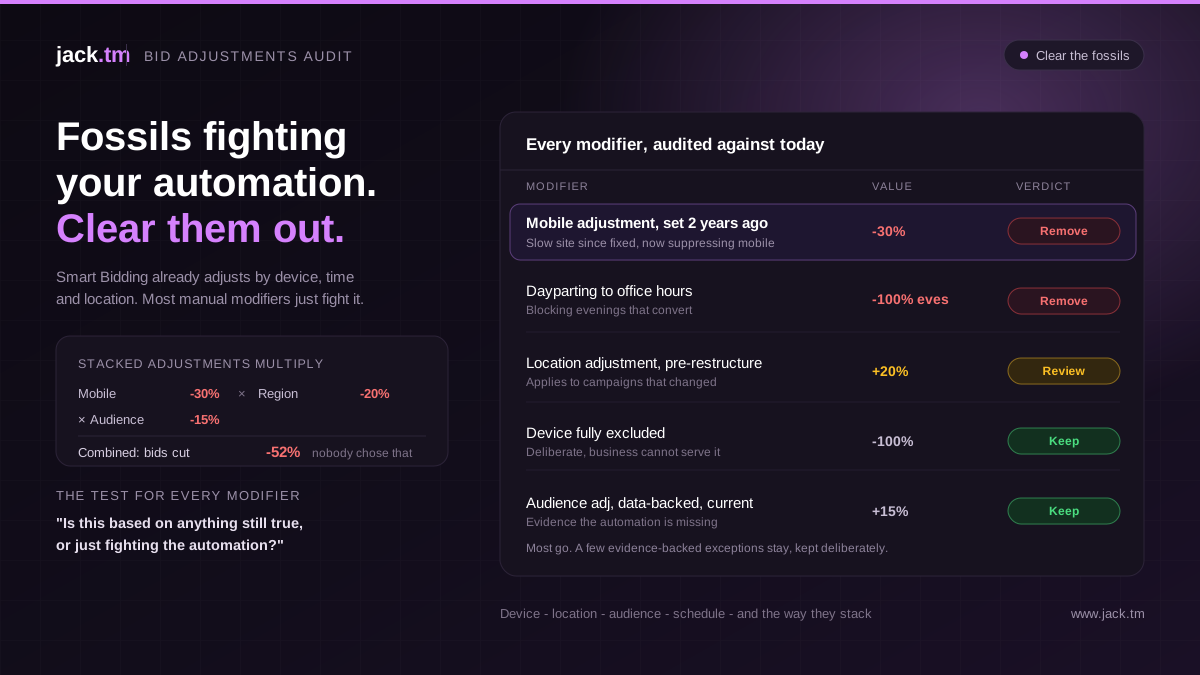
A minus 30% on mobile, from back when the mobile site was slow. A plus 20% on tablets, for a device category that barely matters any more. A location adjustment from a campaign structure that was reorganised a year ago. These modifiers sit quietly in the settings, nudging every bid up or down, long after the reason for them has gone, and in many accounts they are now actively working against the automated bidding that was supposed to make them unnecessary.
Bid adjustments are one of the most set-and-forget parts of an account, and a bid adjustments audit is about asking, of each one: is this still doing what it was meant to, is it based on anything real, and should it exist at all?
The Big Question: Do You Even Need Them?
Before auditing individual modifiers, there is a strategic question that reframes the whole exercise: in a Smart Bidding account, how many bid adjustments should you have at all?
Here is the thing people miss. Smart Bidding already adjusts bids in real time, at auction, based on device, location, time, audience and far more signals than a human can set manually. It is doing, automatically and continuously, the exact job that manual bid adjustments were invented to do by hand.
So when you layer a manual device adjustment on top of Smart Bidding, one of two things happens. Either the adjustment is redundant, because the system was already accounting for device performance, or worse, it is actively fighting the system, overriding a real-time, data-driven decision with a static human guess from the past.
For most target-based Smart Bidding strategies, most manual bid adjustments should not exist. There are specific exceptions, which the audit should identify, but the default finding in a modern account is usually "this modifier is doing more harm than good, remove it." That is the opposite of what most people assume, and it is the single most valuable realisation in a bid adjustments audit.
Important nuance: device adjustments set to minus 100%, which fully exclude a device, still work as hard exclusions even under Smart Bidding. Those are a deliberate targeting choice, not a bid nudge, and the audit treats them differently from a partial plus or minus.
Auditing Device Adjustments
Device is where the oldest and most common legacy adjustments hide.
Audit for:
Device adjustments set long ago for reasons that may no longer apply (the slow mobile site that has since been fixed) Whether device performance differences still exist, or whether the adjustment is correcting a problem that is gone Whether manual device adjustments are layered on top of Smart Bidding, which already handles device Full device exclusions (minus 100%) and whether those exclusions are still intended Whether mobile, desktop and tablet are genuinely performing differently enough to justify any manual intervention
The classic finding: a campaign with a heavy negative mobile adjustment, set years ago, now suppressing mobile traffic that converts perfectly well, because the original reason was fixed long ago and nobody updated the modifier. Mobile is often the majority of traffic now, so a stale negative adjustment there is expensive.
Auditing Location Adjustments
Location bid adjustments overlap with a full location audit, but they belong here too, viewed as modifiers.
Audit for:
Whether location adjustments still match current regional performance Whether they survived a campaign restructure that changed what they apply to Whether they are layered on top of Smart Bidding, which already accounts for geographic performance Whether old adjustments are nudging bids in regions that have since changed character
A location adjustment is only as good as the performance data it was based on, and that data goes stale.
Auditing Audience Adjustments
Audience bid adjustments, applied in observation mode, are a more legitimate tool, but still need checking.
Audit for:
Whether audience adjustments reflect the real performance of those audiences Whether observation-mode audiences carry adjustments that are actually informed by data, or arbitrary guesses Whether audience adjustments conflict with what Smart Bidding is already doing with the same audience signals Whether old audience adjustments survived changes to the audiences themselves
Auditing Ad Schedule Adjustments
Time-of-day and day-of-week adjustments are another legacy favourite.
Audit for:
Whether schedule adjustments reflect real performance patterns or old assumptions Whether Smart Bidding is already handling time-of-day performance, making the manual adjustment redundant Whether dayparting is suppressing hours that actually convert, based on outdated data Whether a business reason for the schedule (phone lines only open certain hours) still applies
A common trap: an account dayparted to office hours because "that's when people buy," while the data shows evening and weekend conversions the schedule is quietly blocking.
The Layering Problem
The real danger with bid adjustments is not any single one. It is how they stack.
Google combines multiple bid adjustments multiplicatively. A device adjustment, a location adjustment and an audience adjustment all applying to the same impression compound together, and the combined effect can be far larger, or far stranger, than anyone intended. Nobody sat down and decided "bids for mobile users in this region in this audience should be 60% lower," but that can be exactly what three stacked adjustments produce.
Audit for:
Where multiple adjustments stack on the same traffic, and what the combined effect actually is Whether the compounded result is deliberate or accidental Whether layered adjustments are producing bids so skewed they effectively exclude traffic nobody meant to exclude Whether the whole stack is fighting Smart Bidding's real-time decisions
This layering is invisible unless you deliberately work out the combined multiplier, and it is where the weirdest, least explainable account behaviour often comes from.
The Exceptions: When Adjustments Still Earn Their Place
To be fair and useful, the audit should recognise where manual adjustments are still legitimate, rather than reflexively removing everything.
Manual bid adjustments can still earn their place when:
You are using a strategy that is not fully automated, where manual control still matters You have a hard business constraint the data does not know (a device or region you genuinely cannot serve, warranting an exclusion) You have strong evidence of a performance difference the automation is demonstrably not accounting for You are deliberately overriding automation for a tested, specific reason
The test is evidence and intent. An adjustment with a current, data-backed reason stays. An adjustment that is just a fossil from a decision made years ago, now layered on top of a system that handles the same thing better, goes.
Scoring and Fixing
Rank the findings. The highest-value fixes are usually removing stale negative device adjustments that are suppressing traffic that converts, because that unlocks volume immediately, and untangling layered adjustments producing unintended combined effects. Be methodical: remove or change one significant adjustment at a time where you can, so the effect is measurable, rather than stripping everything at once and losing the ability to attribute the result.
And accept that the likely conclusion, in a modern Smart Bidding account, is that there should be far fewer manual adjustments than there are. That is usually the right answer, not a reckless one.
Common Bid Adjustment Mistakes
Layering manual device adjustments on Smart Bidding The system already handles device in real time. A manual adjustment is redundant or actively fighting it.
Leaving stale negative mobile adjustments running Set for a problem long since fixed, now suppressing mobile traffic that converts, which is often the majority of traffic.
Ignoring the compounding of stacked adjustments Multiple modifiers multiply together into a combined effect nobody intended.
Dayparting on old assumptions Blocking evening and weekend hours that actually convert, based on "that's when people buy."
Confusing a minus 100% exclusion with a bid nudge Full exclusions still work as hard targeting under Smart Bidding and are a different kind of decision.
Never revisiting adjustments after a restructure Modifiers survive reorganisations and end up applying to things they were never meant to.
How AI Can Help
Finding every bid adjustment across an account, working out which are stale, which conflict with automation and what the layered combinations actually produce, is fiddly, detailed work that rarely gets done by hand.
AI can process:
Every device, location, audience and schedule adjustment in the account Which modifiers are layered on top of Smart Bidding and likely redundant or conflicting Stale negative adjustments suppressing traffic that now converts The combined multiplicative effect where adjustments stack Ranked fixes by impact and confidence
GoogleAdsAudits.com reviews account structure, tracking, bidding, creative, feed and channel mix, then produces a prioritised action plan positioning each recommendation by impact, effort and confidence.
The call on which business constraints still justify a manual override stays with the business.
Final Thoughts
Bid adjustments are the account's accumulated history: a layer of decisions made by various people at various times, for reasons that often no longer apply, quietly nudging bids years later. In an account now run by Smart Bidding, most of them are at best redundant and at worst fighting the very system meant to replace them.
A bid adjustments audit works through each modifier and asks the honest questions: is this based on anything still true, is it duplicating what the automation already does, what does it actually produce when it stacks with the others, and should it exist at all? For most modern accounts, the answer for most adjustments is that they should go, with a small number of evidence-backed exceptions kept deliberately.
Clear out the fossils, untangle the stacks, and let the automation do the job the manual modifiers were invented to do by hand.
Build a personalised Google Ads action plan that identifies wasted spend, scalable opportunities and the fixes your team should prioritise next.
Frequently Asked Questions
Do I still need bid adjustments with Smart Bidding?
Mostly no. Smart Bidding already adjusts bids in real time by device, location, time and audience, using more signals than a human can set manually. Most manual adjustments layered on top are redundant or actively fight the system. A small number of evidence-backed exceptions can stay.
Why is a negative mobile bid adjustment often a problem?
Because many were set years ago for a reason since fixed, such as a slow mobile site, and now suppress mobile traffic that converts perfectly well. Mobile is often the majority of traffic, so a stale negative adjustment there quietly costs a lot of volume.
How do multiple bid adjustments interact?
They combine multiplicatively. A device, location and audience adjustment on the same impression compound together, and the combined effect can be much larger or stranger than intended, sometimes effectively excluding traffic nobody meant to exclude. The stacking is invisible unless you work out the combined multiplier.
Is a minus 100% device adjustment the same as a bid adjustment?
No. A minus 100% fully excludes a device, so it works as a hard targeting exclusion even under Smart Bidding, where a partial plus or minus is often ignored or overridden. Treat full exclusions as a deliberate targeting choice, not a bid nudge.
When should I keep a manual bid adjustment?
When there is current, data-backed evidence of a difference the automation is not accounting for, a hard business constraint the data does not know, a non-automated strategy where manual control still matters, or a deliberate, tested override. The test is evidence and intent, not habit.
Should I remove all my bid adjustments at once?
No. Remove or change significant adjustments one at a time where you can, so the effect is measurable. Stripping everything simultaneously loses the ability to attribute the result, even though the likely overall conclusion is that there should be far fewer.
Does Smart Bidding handle dayparting?
Largely yes; it accounts for time-of-day performance automatically. Manual ad schedule adjustments are often redundant, and dayparting on old assumptions can block evening and weekend hours that actually convert. A genuine business reason, such as phone lines open only certain hours, is a valid exception.