How Much Does a Google Ads Audit Cost? 2026 Pricing Guide
How Much Does a Google Ads Audit Cost? 2026 Pricing Guide
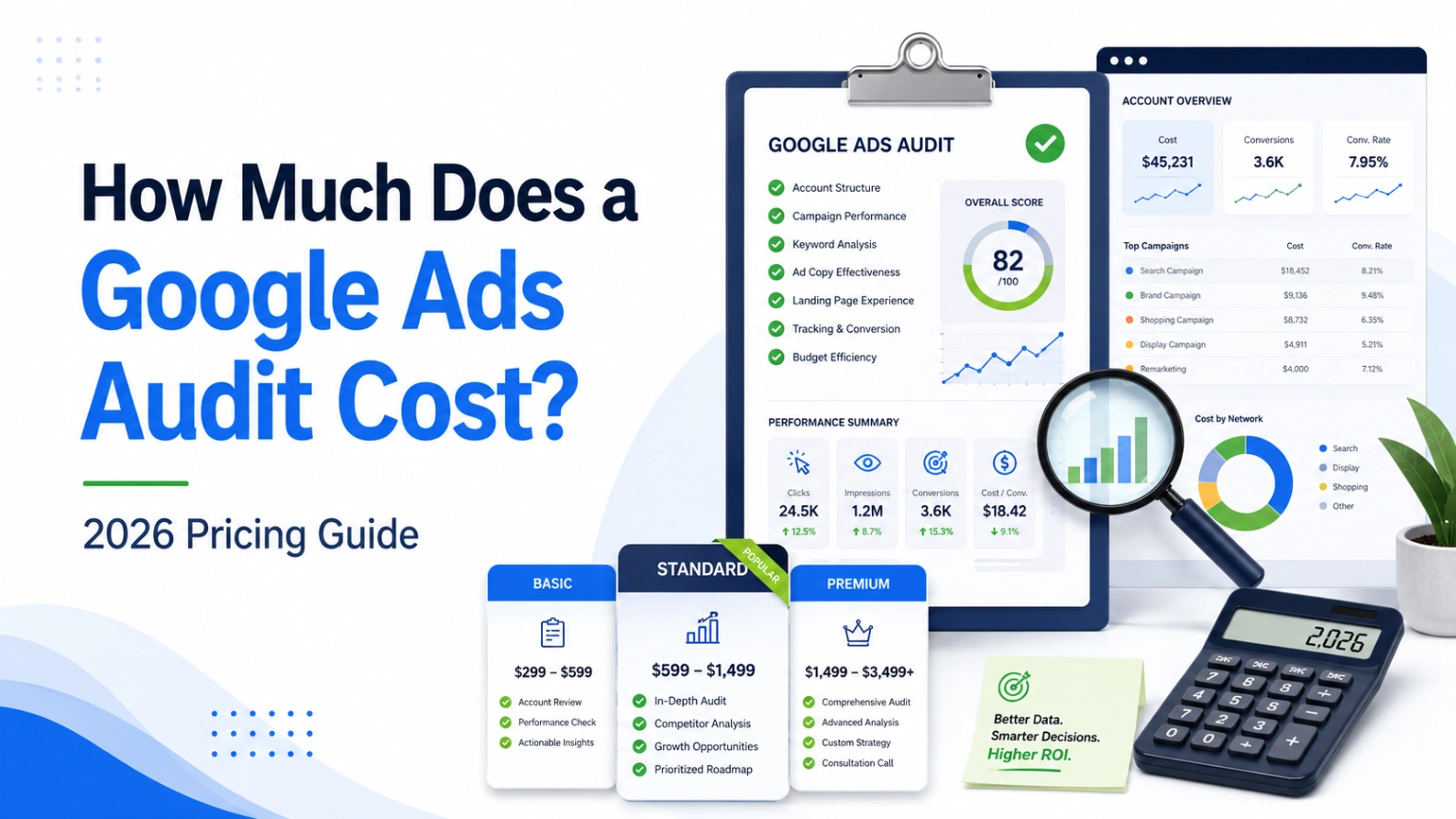
A professional Google Ads audit can cost anywhere from a few hundred pounds to more than £10,000.
The final price depends on the size of the account, the amount of advertising spend being analysed, the number of campaigns and markets involved, the quality of the conversion tracking and the depth of the final report.
Some providers also offer a free Google Ads audit as an initial diagnostic review.
A free audit can be valuable when it examines real account data and produces specific, actionable findings. However, some free audits are primarily sales tools built around generic recommendations.
This guide explains:
How much different types of Google Ads audits cost
What affects Google Ads audit pricing
What should be included in the service
The difference between free and paid audits
How to evaluate whether an audit is worth the investment
What to ask before granting account access
What Is the Average Cost of a Google Ads Audit?
There is no standard industry price for a Google Ads audit.
As an indicative guide, audit costs commonly fall into the following ranges:
Type of audit | Indicative price | Most suitable for |
Automated account scan | Free to £250 | Small accounts needing an initial health check |
Basic manual audit | £300 to £1,000 | Small businesses and relatively simple accounts |
Detailed specialist audit | £1,000 to £3,000 | Established advertisers with multiple campaigns |
Advanced multi-channel audit | £3,000 to £7,500 | Larger ecommerce and lead-generation accounts |
Enterprise audit | £7,500 to £10,000+ | Complex accounts involving multiple countries, brands or teams |
These ranges are not fixed tariffs. Publicly advertised audit prices currently range from approximately £300 plus VAT for smaller reviews to percentage-of-spend models that can reach several thousand pounds for larger accounts.
The correct price depends more on the audit’s scope and depth than the number written on the proposal.
What Determines the Cost of a Google Ads Audit?
Two accounts spending the same amount each month can require very different levels of work.
A single-country lead-generation account with five Search campaigns will usually be easier to audit than an ecommerce account containing thousands of products, several Performance Max campaigns and multiple conversion sources.
The following factors have the greatest effect on Google Ads audit pricing.
1. Monthly Google Ads Spend
Monthly spend is often used as an initial indication of account complexity.
An account spending £2,000 per month will generally contain less data and fewer campaigns than one spending £500,000 per month.
However, spend alone does not determine the amount of work required.
A lower-spending account can still be complicated if it contains:
Many historical campaigns
Multiple countries or languages
Several advertising platforms
Poorly documented conversion tracking
Different business units
Large numbers of products
Several agencies or users making changes
Audit providers should consider account complexity as well as media spend.
2. Number of Campaigns and Ad Groups
A detailed audit may require each important campaign to be assessed individually.
This can include reviewing:
Campaign objectives
Budgets
Bidding strategies
Keywords
Search terms
Negative keywords
Locations
Audiences
Ads
Assets
Landing pages
Conversion goals
An account with 100 active campaigns will naturally require more analysis than an account with five.
Historical and paused campaigns may also need to be reviewed when they contain valuable data or explain recent performance changes.
3. Campaign Types
Some campaign types are more complex to audit than others.
A Search-only account may primarily require analysis of keywords, match types, search terms, negatives, adverts, bidding and landing pages.
A mixed account might include:
Search
Standard Shopping
Performance Max
Demand Gen
Display
Video
App campaigns
Local activity
Microsoft Advertising
Meta Ads
Performance Max audits may also require product-level analysis, brand-overlap checks, asset-group reviews, feed analysis and investigation into how the campaign interacts with existing Search and Shopping activity.
4. Number of Countries, Languages and Brands
International advertising adds additional complexity.
The auditor may need to assess:
Separate market performance
Language targeting
Currency differences
Country-specific budgets
Local landing pages
Regional conversion rates
Search behaviour by market
Duplicate or overlapping campaigns
Brand restrictions
An audit covering ten countries should not normally be priced the same as an equivalent single-market review.
5. Conversion-Tracking Complexity
Conversion tracking is one of the most important parts of a Google Ads audit.
It can also be one of the most time-consuming.
A basic lead-generation account may track a single completed enquiry form. A more complex setup could include:
Online purchases
Dynamic revenue
Phone calls
Form submissions
Booked appointments
Live-chat leads
CRM-qualified leads
Offline sales
Subscription revenue
Profit or margin data
Enhanced conversions
Multiple GA4 properties
Cross-domain tracking
The audit should establish whether Google Ads is receiving accurate data and whether campaigns are optimising towards the correct actions.
Google notes that changing the primary or secondary status of a conversion action affects whether it is used for bidding, making conversion-goal configuration a material part of account performance.
6. The Data Period Being Analysed
A quick audit might assess the previous 30 days.
A deeper review may need to examine:
The previous 90 days
Year-on-year performance
Seasonal changes
Conversion delays
Historical campaign structures
Previous bidding strategies
Budget changes
Website migrations
Tracking updates
A longer analysis period can provide more context, but it also increases the amount of data that must be interpreted.
7. Audit Deliverables
The format of the final audit has a major impact on its price.
Possible deliverables include:
Automated account score
Written summary
Spreadsheet of findings
Prioritised action plan
Detailed PDF report
Video walkthrough
Live presentation
Executive summary
Implementation roadmap
Forecast of potential impact
Support after delivery
A spreadsheet listing 20 issues is not equivalent to a full audit that explains the evidence, priority, expected impact and recommended fix for every finding.
8. Whether Implementation Is Included
An audit identifies what should change.
Implementation involves making those changes.
Some providers include a limited number of fixes within the audit price. Others charge separately for implementation or ongoing management.
Before accepting a proposal, confirm whether the price includes:
Creating new campaigns
Adding negative keywords
Rebuilding conversion tracking
Changing bidding strategies
Writing new adverts
Updating product feeds
Creating reports
Monitoring performance after implementation
An inexpensive audit can become more costly if the final report is too vague for your team to implement.
What Should Be Included in a Google Ads Audit?
The scope should be agreed before access is granted or payment is made.
At a minimum, a professional Google Ads account audit should cover the following areas.
Conversion Tracking
The auditor should review:
Primary and secondary conversion actions
Duplicate conversions
Missing conversions
Conversion values
Attribution settings
Enhanced conversions
Offline conversion imports
Phone-call tracking
GA4 and Google Ads discrepancies
Optimisation decisions are only as reliable as the data being used to make them.
Search Terms and Negative Keywords
The audit should identify:
Irrelevant searches
Informational traffic
Competitor traffic
Job searches
Customer-support searches
Poor-quality lead queries
Missing negative keywords
Valuable searches not currently targeted directly
The objective is not simply to reduce traffic. It is to remove low-value traffic while retaining searches with genuine commercial potential.
Campaign Structure
The review should assess whether the structure provides the right balance between data consolidation and control.
Potential issues include:
Brand and non-brand traffic combined
Too many low-volume campaigns
Countries mixed together
Different services placed in one ad group
Duplicate targeting
Search and Performance Max overlap
Products with different margins sharing one budget
Bidding Strategies
A bidding audit should examine:
Maximise Conversions
Maximise Conversion Value
Target CPA
Target ROAS
Manual CPC
Portfolio bid strategies
Budget limitations
Unrealistic bidding targets
Conversion-volume requirements
Recent strategy changes
The auditor should explain whether the existing bidding strategy suits the campaign’s objective and available data.
Budget Allocation
The audit should compare each campaign’s share of spend against its share of:
Conversions
Revenue
Profit
Qualified leads
New customers
Conversion value
This can reveal high-performing campaigns that are restricted while weaker activity continues to consume budget.
Keywords and Match Types
The analysis should cover:
Exact, phrase and broad match performance
Keyword duplication
Low-volume keywords
High-cost non-converting keywords
Missing high-intent terms
Search-term relevance
Keyword-to-ad alignment
Keyword-to-landing-page alignment
Match types should be judged by the searches and results they generate—not solely by platform recommendations.
Advertisements and Assets
The auditor should review whether ads:
Match the user’s intent
Include meaningful differentiators
Clearly describe the offer
Use relevant calls to action
Match the landing page
Contain accurate information
Avoid unnecessary repetition
Sitelinks, callouts, images, structured snippets, promotions and other assets should also be checked.
Landing Pages
A Google Ads audit should not stop at the advert.
Landing pages should be assessed for:
Relevance
Mobile usability
Page speed
Message consistency
Product availability
Trust signals
Calls to action
Form length
Navigation
Conversion friction
Sending more traffic to a weak landing page will rarely solve the underlying problem.
Performance Max
A Performance Max audit should consider:
Brand cannibalisation
Search overlap
Search-term insights
Asset groups
Audience signals
Search themes
Final URL expansion
Automatically created assets
Listing groups
Product performance
Placement quality
New-customer settings
Blended campaign-level ROAS may hide major differences between branded searches, products, locations and customer types.
Change History and Automated Recommendations
The change history can be used to compare account edits with changes in impressions, clicks, conversions and cost. Google currently retains change-history information for the previous two years.
The audit should investigate:
Budget changes
Bidding-strategy changes
Added keywords
Removed negatives
Conversion-goal edits
Campaigns being paused or enabled
Automated changes
Third-party tool activity
Auto-apply recommendation settings should also be checked. Google allows selected recommendation categories to be applied automatically and provides a history of that activity.
Free Google Ads Audit vs Paid Google Ads Audit
A free Google Ads audit is not automatically less useful than a paid audit.
The value depends on the quality and specificity of the analysis.
When a Free Google Ads Audit Can Be Useful
A free audit can be a good starting point when:
You want an independent second opinion
Performance has recently declined
You suspect budget is being wasted
You are reviewing your current agency
You want to identify the largest immediate problems
You are considering increasing spend
You are unsure whether a full paid audit is necessary
A good free audit should still produce findings that are specific to your account.
For example:
£4,200 spent on irrelevant queries
Brand traffic incorrectly included in non-brand reporting
Three primary conversion actions recording the same lead
Target ROAS restricting a high-performing campaign
Performance Max capturing searches already covered by Search
High-intent terms missing from the account
When a Paid Audit May Be More Appropriate
A paid audit is more appropriate when:
The account is highly complex
Several countries or brands are involved
Detailed tracking validation is required
Legal or compliance requirements apply
You need product-level ecommerce analysis
Multiple advertising platforms must be reviewed
You require a board-level report
Financial modelling or forecasting is required
The audit must include implementation support
The most important distinction is not free versus paid. It is whether the scope matches the complexity of the account.
Is a Free Google Ads Audit Just a Sales Pitch?
Some free audits are designed primarily to secure a management contract.
Warning signs include:
Recommendations are produced before account access is provided
Every finding suggests increasing spend
The report repeats Google’s optimisation recommendations
No evidence is provided
The provider refuses to share the full findings
The recommendations require a long-term contract
The audit uses fear-based language
The auditor cannot explain how priorities were determined
A useful audit should remain valuable even when you choose not to purchase any additional service.
GoogleAdsAudits.com provides an independent audit with read-only access, no credit card requirement and a prioritised report delivered in under 24 hours.
Is It Safe to Give Someone Access to Google Ads?
You should not need to provide your password.
Google Ads allows account owners to invite another user and select an appropriate access level.
Read-only access allows a user to view campaigns and use planning tools without providing standard or administrative editing permissions.
Before granting access:
Confirm the auditor’s identity
Use read-only access where possible
Never share your Google password
Review who currently has account access
Check linked manager accounts
Remove access after the audit if it is no longer required
Avoid granting billing or administrator access unnecessarily
A Google Ads audit normally does not require permission to change campaigns.
How to Compare Google Ads Audit Providers
Do not compare providers on price alone.
Ask the following questions before choosing an audit service.
Will the Account Be Reviewed Manually?
Automated tools can quickly identify configuration problems, but they may not understand the commercial context behind the account.
The strongest audits combine automated data analysis with manual expert review.
Who Will Complete the Audit?
Find out whether the work will be completed by:
The person selling the service
A senior Google Ads specialist
A junior account executive
An outsourced team
An automated platform
The reviewer should have experience with accounts similar to yours.
What Data Period Will Be Analysed?
Thirty days may be insufficient for seasonal businesses, higher-value products or accounts with long sales cycles.
The period should reflect:
Conversion lag
Sales cycle
Seasonality
Recent changes
Available data volume
Will Findings Be Prioritised?
A list of 100 unranked recommendations can create more confusion than clarity.
Every finding should ideally include:
Priority
Evidence
Reason
Recommended action
Likely impact
Confidence level
Critical tracking errors should not be placed alongside minor advert-writing suggestions without distinction.
Does the Audit Consider Revenue and Profit?
Clicks and conversions do not always represent commercial success.
Where data is available, the audit should consider:
Revenue
Gross profit
Contribution margin
Lead quality
Sales-qualified leads
New-customer value
Lifetime value
An account generating a large number of low-quality leads may still appear successful when judged only by cost per conversion.
Will You Receive the Full Report?
Confirm that you will be able to keep the final audit.
Avoid services that only show findings during a sales call or refuse to provide the underlying analysis.
Are There Any Additional Commitments?
Check whether accepting the audit requires:
A management contract
Minimum monthly spend
Software subscription
Implementation fee
Sales consultation
Long notice period
A genuinely independent audit should make these conditions clear before you proceed.
Is a Google Ads Audit Worth the Cost?
An audit is worth paying for when the value of the identified improvements is likely to exceed the cost of the review and implementation.
Consider an advertiser spending £50,000 per month.
If an audit identifies that 10% of spend is going towards irrelevant or commercially weak traffic, that represents £5,000 per month in potential budget reallocation.
Even when only part of that amount can be recovered, the value may exceed the price of the audit.
However, an audit should not promise guaranteed savings or revenue growth.
Some findings will be:
Confirmed errors
Strong recommendations
Testable hypotheses
Longer-term opportunities
A trustworthy auditor should distinguish between these categories.
The Cost of Not Auditing Your Account
The most expensive option is not always the provider with the highest fee.
Continuing to run an account with unresolved problems can cost significantly more.
Potential hidden costs include:
Ongoing irrelevant clicks
Duplicate conversion reporting
Poor-quality leads
Restrictive bidding targets
Incorrect location targeting
Brand and non-brand reporting confusion
Unprofitable products receiving budget
Missed high-intent keywords
Performance Max overlap
Decisions based on inaccurate data
Small inefficiencies become material when they continue every month.
When Should You Request a Google Ads Audit?
Consider arranging an audit when:
Performance has declined unexpectedly
CPA has increased
ROAS has fallen
Lead quality has deteriorated
Spend has increased without equivalent revenue growth
A new agency has taken over
You are considering changing agencies
Conversion tracking has recently changed
The website has been rebuilt or migrated
You are preparing to increase budget
Performance Max has taken a larger share of spend
The account has not received an independent review in the last year
You do not need to wait until performance is poor.
An audit can also identify opportunities to scale an already successful account.
How to Get More Value From Your Audit
Before the review begins, provide the auditor with:
Your main commercial objectives
Target CPA or ROAS
Most valuable products or services
Gross-margin information where appropriate
Lead-quality feedback
Seasonal context
Recent website or tracking changes
Known account concerns
Current budget limits
Internal reporting requirements
This context helps the auditor distinguish between a genuine problem and an intentional business decision.
Get a Free Google Ads Audit
You do not necessarily need to spend thousands of pounds to identify the biggest issues in your Google Ads account.
GoogleAdsAudits.com provides a free account audit covering:
Wasted spend
Search terms and negative keywords
Bidding strategies
Campaign structure
Conversion tracking
Growth opportunities
The account is reviewed using read-only access, so no campaigns or settings can be changed.
You will receive a prioritised report explaining:
What was found
Why it matters
Which campaigns are affected
What should be changed
Which actions should be completed first
There is no credit card requirement and the report is delivered in under 24 hours.
Request your free Google Ads audit and discover which problems and growth opportunities may be hidden inside your account.
Frequently Asked Questions
How much should a Google Ads audit cost?
A Google Ads audit can cost from approximately £300 for a smaller manual review to £10,000 or more for a complex enterprise audit. The price depends on account size, campaign types, countries, tracking complexity and required deliverables.
Can I get a Google Ads audit for free?
Yes. Some specialists and platforms offer free Google Ads audits. Check whether the audit uses real account data, includes manual analysis and provides specific recommendations that you can keep.
What is included in a Google Ads audit?
A detailed audit should cover conversion tracking, search terms, negative keywords, campaign structure, bidding, budgets, adverts, assets, landing pages, Performance Max and growth opportunities.
Does a Google Ads audit require administrator access?
No. Read-only access is generally sufficient for an account audit because the reviewer needs to analyse the account rather than make changes.
How long does a Google Ads audit take?
The required time depends on account complexity. A focused initial audit may be delivered within 24 hours, while a detailed enterprise review can require considerably longer.
Is a Google Ads audit the same as Google Ads management?
No. An audit reviews the account and recommends changes. Ongoing management includes implementing changes, monitoring results, running tests and continually optimising performance.
Will a Google Ads audit improve my ROAS?
An audit cannot guarantee a higher ROAS. It can identify tracking errors, wasted spend, bidding problems and missed opportunities that may be limiting performance. Results depend on the quality of the recommendations and their implementation.
How frequently should I audit Google Ads?
A wider independent audit is often useful at least once a year and after major changes in performance, tracking, websites, budgets or account management. Search terms, budgets and conversion data should be reviewed more frequently.
AUTHOR BIO
Jack Felstead is an independent Paid Media and Digital Growth Consultant with 17 years of experience helping businesses improve advertising revenue, efficiency and return on investment across Google Ads and other paid media platforms.