Google Ads Wasted Spend: 17 Ways Your Budget Is Being Lost
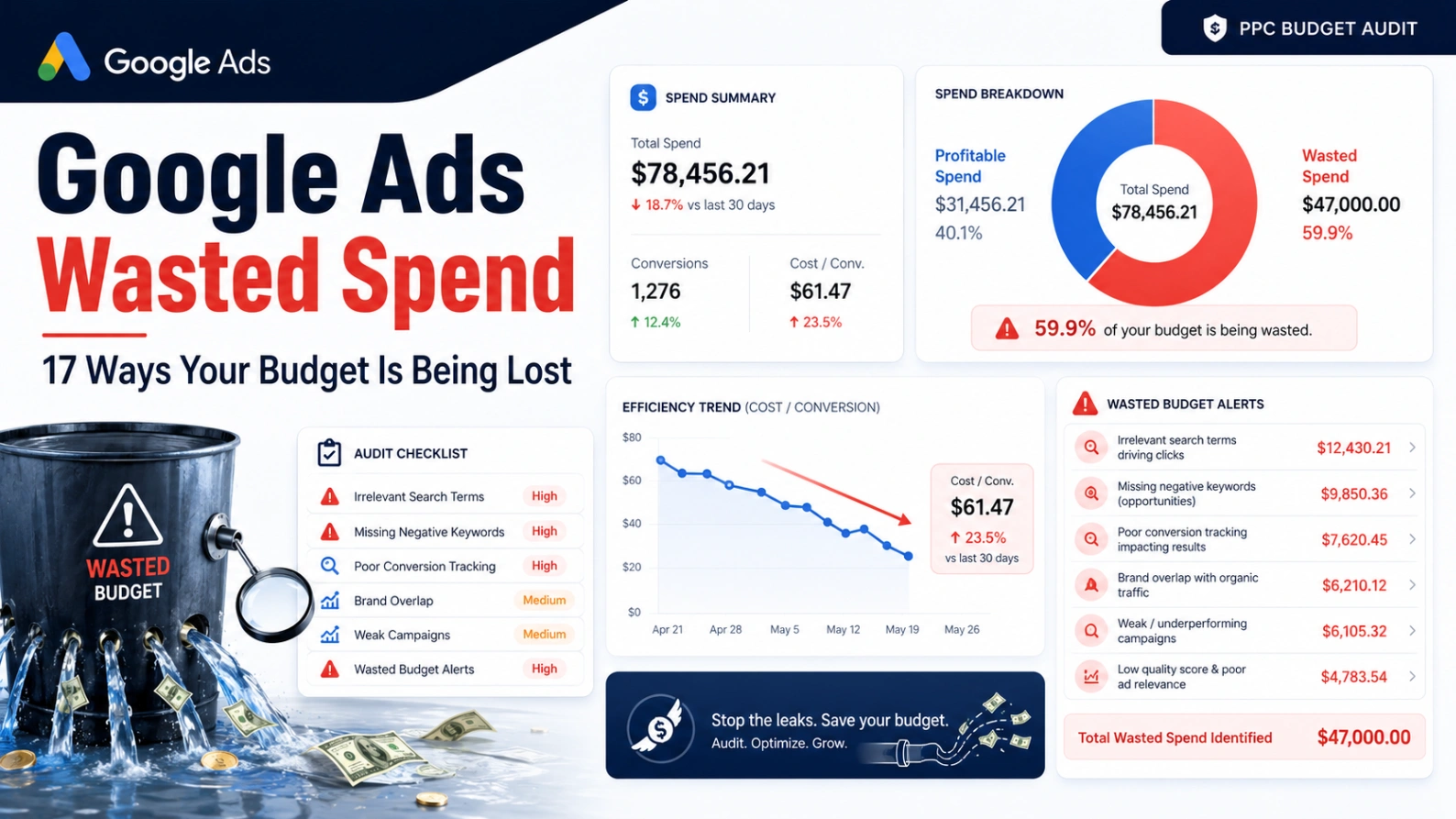
Google Ads Wasted Spend: 17 Ways Your Budget Is Being Lost
Google Ads wasted spend is rarely caused by one dramatic mistake.
It usually accumulates through dozens of smaller problems:
Irrelevant search terms
Missing negative keywords
Poor conversion tracking
Weak campaign structure
Overlapping campaigns
Unsuitable bidding strategies
Budgets directed towards low-value traffic
Each issue may appear relatively minor in isolation. Combined, they can consume a significant portion of the account’s budget without generating enough commercially valuable conversions.
The challenge is that Google Ads can still report clicks, impressions and conversions while these problems exist. An account may therefore appear active and successful without being genuinely efficient.
A structured Google Ads audit helps identify where money is being lost, estimate the commercial impact and prioritise the changes most likely to improve performance.
Here are 17 of the most common causes of Google Ads wasted spend.
What Counts as Wasted Spend in Google Ads?
Wasted spend is advertising cost that does not make a sufficient contribution towards the business’s real objectives.
That may include spend on:
Searches unrelated to the product or service
Users outside the target market
Duplicate or inaccurate conversions
Leads that never become qualified opportunities
Products with insufficient margin
Brand traffic being credited as new demand
Campaigns unable to achieve the required CPA or ROAS
Landing pages that fail to convert relevant visitors
Not every non-converting click is automatically waste.
Some users research before purchasing, conversions can occur after a delay, and upper-funnel campaigns may influence later demand.
The aim is to distinguish between activity that supports the customer journey and spend that has repeatedly produced little commercial value.
1. Irrelevant Search Terms
Keywords are not the same as the searches people actually type.
Your keyword may be:
google ads consultant
But the search terms triggering it could include variations such as:
Google Ads consultant jobs
Free Google Ads course
Google Ads consultant salary
How to become a Google Ads consultant
Google Ads support phone number
These searches may contain the target phrase while having completely different intent.
Google’s search terms report shows queries that triggered ads and can be used to identify irrelevant searches or discover valuable new keywords.
Review search terms using:
Cost
Conversions
Conversion value
Lead quality
Search intent
Relevance to the landing page
Do not only exclude terms because they have not converted after one or two clicks. Prioritise clear intent mismatches and terms that have accumulated meaningful spend.
2. Missing Negative Keywords
Negative keywords prevent ads from appearing for selected words or phrases.
Common examples include:
Free
Jobs
Salary
Course
Training
Definition
Template
DIY
Second-hand
Complaints
The correct list depends entirely on the business.
A training provider may want “course” traffic, while a consultancy may need to exclude it.
Google allows negative keywords to be added at ad-group, campaign or shared-list level. They can be identified directly through the search terms report.
Avoid creating excessively aggressive negative lists. Poorly selected negatives can block relevant searches alongside the unwanted traffic.
3. Match Types Are Too Broad for the Available Data
Google Ads offers broad, phrase and exact keyword matching.
Broad match can reach a wider variety of searches, while exact match provides tighter control over the searches eligible to trigger an ad.
Broad match can work effectively when an account has:
Reliable conversion tracking
Strong conversion volume
Appropriate Smart Bidding
Well-maintained negatives
Clear conversion values
Regular search-term reviews
It becomes riskier when the account has weak measurement, limited data or several unrelated conversion actions.
For tighter control, use exact and phrase match for commercially important terms, then introduce broader coverage through controlled tests rather than converting an entire account at once.
4. Brand and Non-Brand Traffic Are Mixed Together
Brand searches normally convert differently from generic searches.
Someone searching directly for your business already knows the brand. Someone searching for a general product or service may be discovering it for the first time.
Combining both traffic types can:
Inflate campaign conversion rates
Make CPA appear lower
Make ROAS appear stronger
Hide weak generic acquisition performance
Prevent accurate budget allocation
Separate brand and non-brand activity wherever the volume justifies it.
This allows you to measure how much budget is capturing existing demand compared with generating new demand.
5. Performance Max Is Absorbing Brand Traffic
Performance Max may serve on branded searches, including searches that could otherwise have been captured through a dedicated Search campaign.
Google provides brand exclusions for Search and Performance Max campaigns. It specifically recommends brand exclusions where advertisers want to prevent Performance Max from serving against their own brand or other selected brands.
This does not mean brand traffic should always be excluded.
The decision depends on:
Your campaign objectives
Shopping coverage
Search campaign eligibility
Incrementality
Budget
The value of controlling brand messaging
However, failing to understand how much branded traffic sits inside Performance Max can make its reported performance appear more incremental than it really is.
6. Conversion Tracking Is Inaccurate
Automated bidding is only as useful as the conversion data supporting it.
Common tracking problems include:
Purchases firing twice
Form submissions counted without successful completion
Calls counted regardless of duration
Page views imported as primary conversions
Revenue missing or using the wrong currency
Transactions recorded without unique IDs
Test orders included in reporting
Consent or cross-domain problems
CRM outcomes never imported
A campaign can appear efficient because it is generating conversions that have little or no business value.
Audit every primary conversion and answer:
What exact action triggers it?
Does it fire once?
Is the value accurate?
Should bidding optimise towards it?
Can it be connected to a sale or qualified outcome?
Enhanced conversions can supplement existing tracking with hashed first-party data and may improve measurement accuracy and bidding signals.
7. The Wrong Actions Are Included as Primary Conversions
Not every tracked action should guide bidding.
Micro-conversions such as:
Viewing a contact page
Starting a form
Clicking an email address
Spending time on the website
Adding a product to a basket
can be useful for analysis.
But if they are included as primary conversion goals alongside completed purchases or qualified leads, Google may prioritise the easiest actions rather than the most valuable outcomes.
Separate:
Primary conversions used for bidding
Secondary conversions used for observation
For ecommerce, the primary action will normally be a completed purchase.
For lead generation, it may be a valid form, qualified opportunity or completed sale depending on the available data volume.
8. Cheap Leads Are Being Mistaken for Good Leads
A low cost per lead does not guarantee a profitable campaign.
One campaign may generate 50 leads at £30 each but only one qualified opportunity. Another may generate 20 leads at £60 each but produce five customers.
The first campaign has the lower platform CPA.
The second may create substantially more revenue and profit.
Connect Google Ads with CRM outcomes such as:
Valid lead
Contacted lead
Qualified lead
Opportunity
Proposal
Sale
Revenue
Margin
Without this data, bidding can favour campaigns producing easy forms rather than commercially valuable customers.
9. The Bidding Strategy Does Not Suit the Campaign
Common bidding problems include:
Target CPA introduced without enough reliable conversions
Target ROAS used without accurate conversion values
Maximise Conversions spending the full budget on low-value actions
Manual bids left unchanged for months
Several campaigns competing for limited conversion volume
Targets copied between campaigns with different economics
Review whether the strategy matches:
The campaign objective
Conversion volume
Conversion delay
Available budget
Value accuracy
Historical CPA or ROAS
New-customer goals
A more advanced bidding strategy is not automatically a better bidding strategy.
10. Targets Are Too Aggressive—or Too Loose
An unrealistic Target CPA can restrict traffic and prevent campaigns from entering valuable auctions.
A very loose target can have the opposite effect, allowing Google to bid aggressively and consume budget at an unprofitable cost.
Target ROAS has the same tension.
A target that is too high may suppress volume. A target that is too low may generate revenue without sufficient margin.
Compare targets with:
Recent actual performance
Break-even CPA
Break-even ROAS
Conversion lag
New-customer value
Product margin
Available budget
Targets should reflect the economics of the business rather than a number selected because it appears efficient.
11. Budget Is Trapped in Weak Campaigns
Accounts often continue funding campaigns because they have always existed.
Review each campaign’s share of:
Spend
Conversions
Revenue
Qualified leads
New customers
Profit
A campaign consuming 25% of spend but generating 5% of commercial value requires investigation.
At the same time, a profitable campaign may be limited by budget while weaker activity continues spending.
Budget optimisation is not simply reducing total cost. It is moving investment from low-confidence activity towards stronger opportunities.
12. Location Targeting Is Too Broad
Location settings can waste spend when campaigns target:
Entire countries instead of serviceable areas
Regions with poor fulfilment economics
Users merely interested in a location
Locations outside the sales team’s coverage
Areas with consistently weak lead quality
Analyse performance by:
Country
Region
City
Radius
Store or service area
Check both the selected locations and the location options controlling user presence and interest.
A campaign targeting London businesses should not automatically pay for users outside London whose searches merely mention the city unless that is intentional.
13. Device, Time and Audience Performance Is Ignored
Automated bidding adjusts bids using many contextual signals, but this does not remove the need for analysis.
Look for persistent differences across:
Mobile, desktop and tablet
Working hours and overnight traffic
Weekdays and weekends
New and returning users
Customer lists
Age and demographic groups where available
A large difference does not always justify an immediate exclusion. It may reveal a deeper issue.
For example, weak mobile performance may indicate:
Slow landing pages
Broken forms
Poor mobile navigation
Difficult checkout
Calls not being tracked
Fix the cause before simply excluding the traffic.
14. Ads and Landing Pages Do Not Match
A user searching for a specific service should not land on a broad homepage with no clear connection to the query.
Misalignment can reduce conversion rates even when the traffic is relevant.
Review the chain:
Search term → keyword → ad → landing page → conversion action
The messaging should remain consistent throughout.
Check:
Is the search intent reflected in the headline?
Does the landing page immediately confirm relevance?
Is the offer clear?
Is the CTA visible?
Does the page work properly on mobile?
Is important information hidden below generic content?
Improving landing-page relevance can recover value from traffic you are already paying for.
15. Campaigns Are Overlapping
Multiple campaigns may compete for similar searches, products or audiences.
Common examples include:
Search campaigns targeting the same keywords
Generic Search overlapping with Performance Max
Several Performance Max campaigns containing the same products
Brand keywords appearing in generic campaigns
Duplicate geographic campaigns
Old campaigns left enabled after a rebuild
Overlap makes reporting harder and can direct traffic to the wrong campaign, budget or landing page.
Map which campaign should own each:
Brand
Product category
Service
Location
Customer type
Funnel stage
The purpose is not to eliminate every overlap. It is to ensure overlap is intentional and measurable.
16. Revenue Is Being Optimised Instead of Profit
Two products can sell for £100 while producing completely different margins.
If Google receives £100 as the conversion value for both, it considers them equally valuable.
But one may generate £60 of contribution profit while the other generates £15.
Review performance using:
Product margin
Cost of goods sold
Returns
Delivery
Payment fees
New-customer value
Repeat-purchase value
A high-ROAS campaign can still waste budget if most of its revenue comes from low-margin products.
17. The Account Is Never Audited Independently
People naturally become accustomed to the accounts they manage.
An independent audit can identify:
Assumptions that are no longer valid
Settings changed by platform updates
Campaigns that have gradually deteriorated
Tracking problems
Search-term waste
Structural duplication
Missed growth opportunities
GoogleAdsAudits.com offers an independent, read-only audit covering search terms, wasted spend, bidding, campaign structure, conversion tracking and growth opportunities, delivered as a prioritised report.
The purpose of an audit is not to create the largest possible list of changes.
It is to distinguish between:
Critical problems
High-confidence waste
Lower-priority improvements
Tests
Genuine opportunities to scale
How to Estimate Your Google Ads Wasted Spend
There is no single perfect wasted-spend metric.
A practical starting point is to group spend into categories:
Confirmed waste
Traffic that is clearly irrelevant or outside the target market.
High-confidence waste
Activity with meaningful spend, sufficient data and no valuable commercial outcomes.
Unverified spend
Traffic that may be valuable but cannot be assessed properly because tracking or CRM data is incomplete.
Strategic investment
Activity intentionally supporting awareness, research or future demand.
Do not label every non-converting cost as waste.
Use appropriate lookback windows and account for conversion delay, sales cycles and repeat purchases.
A Quick Google Ads Waste Audit
Start with these five reports:
Search terms: Find irrelevant intent and missing negatives.
Campaign performance: Compare share of spend with share of value.
Conversion actions: Confirm what bidding is actually optimising towards.
Locations and devices: Identify persistent performance gaps.
Products or landing pages: Find traffic directed towards weak-margin or low-converting destinations.
Then rank findings by:
Estimated cost
Confidence
Ease of implementation
Commercial impact
Risk
Fix the clearest measurement and targeting problems before making major bidding changes.
How Often Should You Audit Google Ads?
A complete independent audit may be useful:
Before changing agency or consultant
After a major performance decline
Before significantly increasing budget
After tracking or website changes
Following a campaign restructure
When lead quality declines
When reported ROAS no longer matches business results
At least periodically for large or complex accounts
Search terms, budgets and tracking should be checked more frequently as part of normal account management.
Final Thoughts
Google Ads wasted spend is not limited to irrelevant clicks.
It can also come from inaccurate tracking, poor-quality conversions, unsuitable bidding, low-margin products and campaigns taking credit for demand they did not create.
The strongest audit process follows three stages:
Confirm that measurement is reliable.
Identify where spend is producing insufficient commercial value.
Prioritise the changes most likely to improve profit and growth.
A well-run account does not need every click to convert.
It needs every meaningful segment of spend to have a clear purpose, an appropriate measurement framework and a realistic route to commercial return.
Find out where your budget is being wasted and which opportunities deserve greater investment with a free, independent Google Ads audit.
Frequently Asked Questions
What is wasted spend in Google Ads?
Wasted spend is advertising cost that does not make a sufficient contribution towards relevant conversions, revenue, qualified leads or profit.
How can I find wasted spend?
Review search terms, negative keywords, conversion actions, campaign budgets, locations, devices, landing pages, product margins and CRM outcomes.
Are all non-converting clicks wasted?
No. Some users convert later or support a longer research journey. Judge spend using appropriate data volume, conversion delay and commercial intent.
Can broad match cause wasted spend?
Broad match can reach a wider range of searches. It requires reliable conversion data, appropriate bidding and regular search-term monitoring to control irrelevant traffic.
Can Performance Max use brand traffic?
Yes. Performance Max may serve on branded searches. Brand exclusions are available when advertisers want to prevent selected branded queries from being included.
Should I pause every campaign with a poor ROAS?
Not automatically. Check conversion delay, customer value, margins, assisted impact and tracking accuracy before making the decision.
How much Google Ads waste is normal?
There is no universal percentage. The acceptable level depends on margins, objectives, sales cycle and how much controlled exploration the account requires.
What should a Google Ads audit include?
It should review search terms, keywords, negatives, bidding, budgets, structure, conversion tracking, Performance Max, targeting, landing pages and growth opportunities.
AUTHOR BIO
Jack Felstead is an award-winning Paid Media, AI and Digital Growth Consultant with 17 years of experience helping businesses improve customer acquisition, revenue, advertising efficiency and profit.