Search Terms Audit: How to Find the Queries Quietly Draining Your Budget
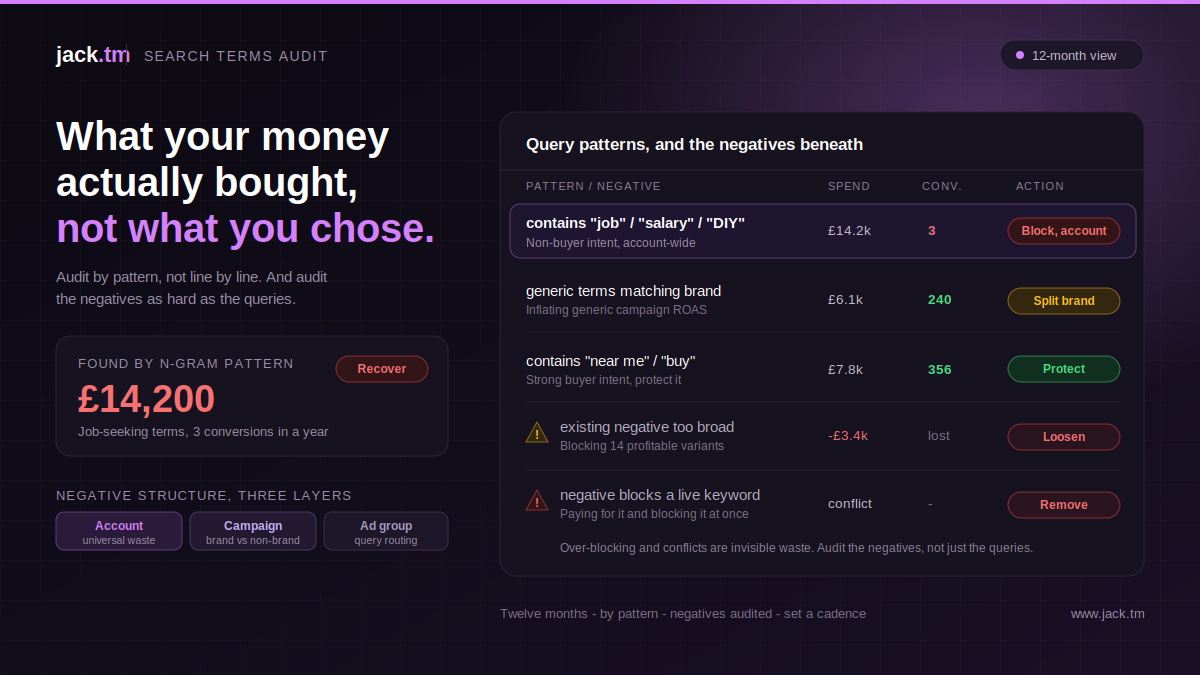
Search Terms Audit: How to Find the Queries Quietly Draining Your Budget
The search terms report is the most honest document in a Google Ads account.
Everything else, the campaign settings, the targeting, the keyword list, describes what you intended to buy. The search terms report shows what you actually bought: the real queries people typed to trigger your ads, with your real money attached. And in most accounts, a meaningful slice of that money is going somewhere nobody would have chosen on purpose.
The reason it stays hidden is not that it is hard to find. It is that most accounts review the report badly, thirty days at a time, scanning for anything obviously wrong, and move on. That approach catches the occasional glaring junk query and misses the slow, structural leaks entirely. A proper search terms audit is a different exercise: systematic, pattern-based, and paired with a hard look at the negative keyword structure underneath.
Here is how to do it, and what to look for that a quick scan always misses.
Why Thirty Days Is the Wrong Window
The single most common mistake is the review window.
Thirty days of search terms shows you recent, high-volume queries. It does not show you the long tail, the hundreds of low-frequency terms that each take a little spend and, added together, amount to real money. A query that shows up twice a month with no conversions looks like nothing in a thirty-day view. Across twelve months, the same pattern has quietly spent a few hundred pounds on nothing, and there are dozens of patterns like it.
The audit window should be twelve months where the data allows, so the structural and seasonal patterns become visible. Recent data still matters more for current performance, but you cannot see a slow leak in a snapshot. You see it over time.
Auditing at Scale: Patterns, Not Lines
On a small account you can read the report line by line. On any account of size, that approach fails, because there are thousands of unique queries and the human eye tunes out.
The technique that works is pattern analysis, often called n-gram analysis. Instead of judging each full query, you break queries into their component words and short phrases and look at which recurring fragments are associated with waste and which with value.
For example, you might find that any query containing "free", "cheap", "job", "salary", "DIY", "how to" or "second hand" converts poorly across the entire account, regardless of the rest of the query. Those words become candidates for account-level negatives in one move, rather than being chased one query at a time. Meanwhile a fragment like "near me", "best" or "buy" might correlate strongly with conversions, and should be protected rather than blocked.
This word-and-phrase view turns an unreadable list of thousands of queries into a manageable set of patterns. It is faster, more thorough, and far more reliable than scrolling and reacting to whatever catches your eye.
What the Audit Is Actually Looking For
A search terms audit is hunting several distinct problems, and lumping them together as "bad queries" leads to blunt, damaging fixes. Each has its own signature and its own remedy.
Zero-converting spend. Queries with meaningful spend and no conversions over a statistically sensible volume. The clearest waste, and the first to quantify.
Converting-but-unprofitable queries. Terms that do convert, but at a cost or margin that loses money once you look past the conversion count. These are more dangerous because they look productive.
Wrong-intent queries. Informational, research, job-seeking or DIY searches that will rarely buy. They may convert occasionally, but the intent is mostly wrong.
Wrong-fit queries. Genuine buyers who are not your buyers: wrong location, wrong sector, below minimum order value.
Brand leakage. Your own brand terms being captured by generic, Shopping or Performance Max campaigns, inflating their apparent performance and corrupting the acquisition picture.
Intent scattered across many terms. The same commercial intent spread across dozens of near-identical queries, splitting data and making everything harder to read and optimise.
Quantify each. "There is wasted spend" is an observation. "£14,200 over twelve months went to queries containing job-seeking terms, with three conversions" is a finding you can act on and rank.
The Other Half: Auditing the Negatives
Most search terms audits stop at "what should we add as a negative?" That is only half the job, and the half everyone does. The other half is auditing the negatives that already exist, which almost nobody does, and which frequently causes more damage than the waste itself.
Negative keyword lists accumulate over years, reactively, with no structure, and they develop problems that are invisible because there is no report for "valuable queries I prevented from ever showing."
Audit the existing negatives for:
Over-blocking. Negatives that are too broad and are silently blocking valuable queries alongside the junk they were meant to stop. A negative added to kill one bad term can take out a dozen profitable variants that shared a word.
Conflicts. Negatives that contradict the positive keywords you are actively bidding on, so you are paying for a keyword and blocking it at the same time. This is more common than it sounds and completely invisible without a deliberate check.
Wrong-level placement. Negatives applied at the wrong level, blocking account-wide what should only have been blocked in one campaign, or vice versa.
Match type errors. Negative broad used too loosely, catching unintended queries, or negative exact where a broader negative was needed, letting variants slip through.
Stale negatives. Negatives added for a reason that no longer applies, now just quietly suppressing traffic.
An account that has only ever had negatives added, never audited, is often starving itself in places nobody can see. Finding that is one of the highest-value and least-performed parts of the whole exercise.
The Negative Keyword Structure
Beyond individual negatives, the audit should assess whether there is any structure at all.
A healthy structure has three layers, each doing a different job. Account-level lists for universal waste that applies everywhere. Campaign-level negatives for separating campaigns from each other, including keeping brand out of generic and non-brand campaigns. Ad-group-level negatives for routing specific queries to the most relevant ad group and landing page.
Audit for: whether these layers exist and are used correctly, or whether the account has an unstructured pile of negatives at random levels, contradicting each other. Universal junk sitting at ad-group level has to be re-added everywhere; traffic-shaping negatives sitting at account level block things they should not. Getting the structure right is often more valuable than any single negative.
Match Type and Automation Interaction
A final dimension the audit should cover: how the search terms interact with your match types and automated bidding.
Broad match plus Smart Bidding explores widely, which is the point, but it means the search terms report and the negative structure are the main controls you have left over what that exploration buys. An account leaning on broad match with a thin or neglected negative structure is an open invitation to waste.
Audit for: whether match type strategy and negative coverage are aligned, whether broad match is being used without the negative discipline it requires, and whether the exploration is being bounded at all or left to run.
Scoring and Fixing
As with any audit, findings need ranking, not just listing.
Fix the highest-value, most certain things first: confirmed zero-converting spend removed via well-scoped negatives, brand leakage closed, obvious over-blocking loosened. Then the pattern-level account negatives from the n-gram work. Then the structural cleanup of the negative lists. Be conservative on anything ambiguous, because some poor-looking queries still produce the occasional genuine sale, and blunt blocking costs more than it saves.
And then set a cadence, because this is the finding that regenerates. Search terms need reviewing weekly or fortnightly depending on spend, with a full twelve-month pattern review and a negative-list audit at least annually. The waste you clear today grows back if nobody looks again.
Common Mistakes
Reviewing thirty days at a time Hides the long-tail and seasonal leaks. Audit twelve months for the patterns.
Scanning line by line on a large account The eye tunes out. Use n-gram pattern analysis to see the whole report at once.
Only ever adding negatives Over-blocking and conflicts accumulate invisibly. Audit the existing negatives, not just the queries.
Blunt, over-broad negatives A negative added to stop one junk term takes out profitable variants that shared a word.
No negative structure An unstructured pile at random levels contradicts itself. Use account, campaign and ad-group layers deliberately.
Ignoring brand leakage Generic and PMax campaigns eating brand queries corrupt every acquisition number above them.
How AI Can Help
Search terms analysis is a volume-and-pattern problem, which is exactly where machines beat manual review. Reading twelve months of queries by hand is slow, and the patterns that matter are easy to miss one line at a time.
AI can process:
Word and phrase patterns across thousands of queries at once Queries that convert to a form or sale versus those that do not Existing negatives that may be blocking valuable traffic, and negative-keyword conflicts Brand leakage across campaign types Ranked negative recommendations by recoverable spend and confidence
GoogleAdsAudits.com reviews account structure, tracking, bidding, creative, feed and channel mix, then produces a prioritised action plan positioning each recommendation by impact, effort and confidence.
The final judgement on which queries are genuinely valuable still needs someone who understands the business behind them.
Final Thoughts
The search terms report shows what your money actually bought, and auditing it properly is one of the fastest routes to recovering wasted spend, because the waste is already being spent and the budget is already approved.
Do it at the right scale: twelve months, by pattern, not thirty days by eye. Hunt the distinct problems, zero-converters, unprofitable converters, wrong intent, wrong fit, brand leakage, rather than lumping them together. Audit the negatives you already have as hard as the queries you want to block, because over-blocking and conflicts cost more than most people realise. Fix in order of value and certainty, then set a cadence so it does not grow back.
It is not glamorous work. It is just reliably the work that pays.
Build a personalised Google Ads action plan that identifies wasted spend, scalable opportunities and the fixes your team should prioritise next.
Frequently Asked Questions
How far back should a search terms audit look?
Twelve months where the data allows, so long-tail and seasonal patterns become visible. Recent data matters more for current performance, but you cannot see a slow, structural leak in a thirty-day snapshot.
What is n-gram analysis for search terms?
Breaking queries into their component words and short phrases to see which recurring fragments are associated with waste and which with value, instead of judging thousands of full queries one by one. It lets you negate a whole pattern in one move and protect the fragments that convert.
Should I audit my existing negative keywords, not just add new ones?
Yes, and almost nobody does. Negative lists accumulate over years and develop over-blocking, conflicts with your own keywords, wrong-level placement and stale entries, all of which silently suppress valuable traffic. Auditing them is often higher value than adding more.
What is a negative keyword conflict?
When a negative keyword blocks a query you are actively bidding on with a positive keyword, so you pay for the keyword and prevent it from showing at the same time. It is invisible without a deliberate check and surprisingly common.
How should negative keywords be structured?
In three layers: account-level lists for universal waste, campaign-level negatives for separating campaigns and keeping brand out of non-brand, and ad-group-level negatives for routing queries to the right ad group. An unstructured pile at random levels contradicts itself.
Do I still need to audit search terms with broad match and Smart Bidding?
More than ever. Automation decides which queries to enter, and the search terms report plus the negative structure are the main controls you have left over what it buys. Broad match without negative discipline is an open invitation to waste.
How often should search terms be reviewed?
Weekly or fortnightly depending on spend for ongoing management, with a full twelve-month pattern review and a negative-list audit at least once a year. The waste you clear regenerates if nobody looks again.