Smart Bidding Targets: How to Set, Audit and Change tCPA and tROAS
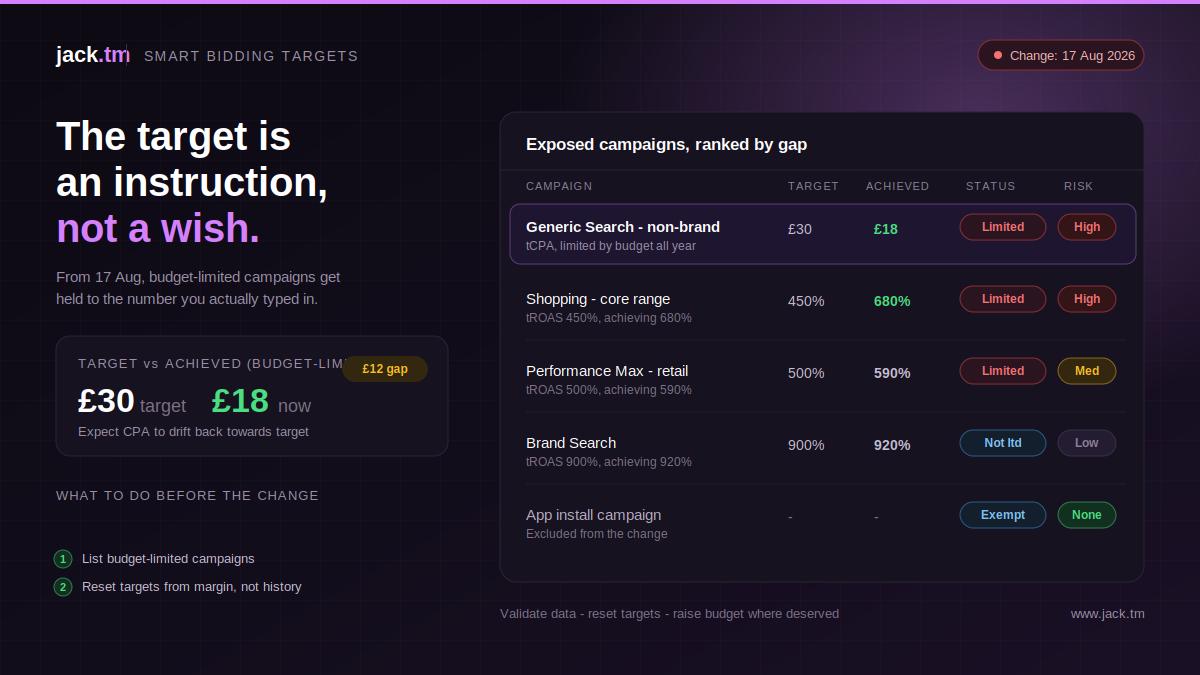
A bidding target is not a preference. It is an instruction.
Most accounts do not treat it that way. Targets get set once during a launch, adjusted twice in a panic, and then left alone for a year while the business, the margins and the market all change around them.
That has been survivable, because budget-limited campaigns using Target CPA or Target ROAS have frequently beaten their stated targets. An advertiser sets a £20 CPA target and gets £13. A retailer sets a 500% ROAS target and gets 700%. Nobody complains about a campaign that overdelivers, so nobody revisits the number.
That gap is closing.
What Is Changing on 17 August 2026
Google has confirmed that from 17 August 2026, budget-limited campaigns using Target CPA or Target ROAS will be steered much more closely towards the target that has actually been entered, rather than the more efficient result the system had been delivering within the budget constraint.
The stated purpose is tighter alignment between the goal an advertiser sets and the result the campaign produces.
The practical effect for many accounts is the opposite of what it sounds like. Campaigns that have been comfortably beating their targets are likely to drift back towards them, which means a higher CPA or a lower ROAS than the account has been used to seeing.
Points worth being clear on:
The change applies to campaigns using Target CPA or Target ROAS that are constrained by budget It covers Search, Shopping, Performance Max, Demand Gen, Display, Hotel and Travel campaigns App campaigns, video reach and video view campaigns are excluded Google is not changing anyone's targets or budgets automatically A Bid Target Adjustment Tool began rolling out from 6 July 2026, flagging potentially affected campaigns and suggesting targets based on recent performance
Notification emails were issued to affected accounts in early July. If your account received one and nobody acted on it, that is the first item on the list.
Separately, and unrelated to performance, the bid strategy naming changed from June 2026. "Maximise conversions with a Target CPA" is now labelled "Target CPA", and "Maximise conversion value with a Target ROAS" is now "Target ROAS". The behaviour is unchanged. It is a labelling update, not a strategy change, though it does cause confusion in reporting and documentation.
What to Do Before 17 August
There are roughly three weeks left at the time of writing. The work is not complicated, but it does need doing deliberately rather than reactively.
1. List every affected campaign
Pull every campaign using Target CPA or Target ROAS that has shown a "Limited by budget" status at any point in the last twelve months. That is the exposed set.
2. Compare target against achieved performance
For each one, record the entered target and the actual result over the last 90 days. The size of the gap is the size of the risk.
A campaign on a £30 target delivering £18 has a large gap. A campaign on a £30 target delivering £29 has almost none.
3. Decide what the target should actually be
This is the real question, and most accounts have never answered it properly. See the next section.
4. Adjust targets before the change, not after
Moving a target towards reality in advance is a controlled change you can measure. Reacting to a performance shift in late August is not.
5. Check the conversion data first
If the tracking is inaccurate, every target in the account is set against a fictional number. Validate values, duplicates and primary conversion actions before touching a single target.
How to Set a Target Properly
A target should come from the commercial position, not from last month's average.
For ecommerce
Work backwards from margin.
Gross margin percentage Fulfilment, delivery and payment costs Return rate Repeat purchase value, if you are willing to acquire at a loss on the first order Any fixed contribution the business needs per order
A product range at 45% gross margin cannot sustain the same ROAS target as one at 18%, and averaging the two across a single campaign guarantees that one of them is wrong.
For lead generation
Work backwards from the sale.
Average contract or order value Gross margin Lead to opportunity rate Opportunity to sale rate Acceptable customer acquisition cost
If 100 leads produce 12 sales at £900 gross profit each, that is £10,800 of profit. A £40 cost per lead is £4,000 of cost against it. That is the calculation the target should reflect, not the cost per lead the account happened to produce last quarter.
The honest version
Most accounts set targets by looking at what the campaign has been achieving and typing in something slightly better. That is not a target. It is a description of the past with an optimistic rounding.
Targets, Budgets and Volume
The three are connected, and treating them separately produces most of the confusion around Smart Bidding.
A more aggressive efficiency target usually reduces volume, because the system enters fewer auctions.
A looser target usually increases volume and reduces efficiency.
A budget constraint caps volume regardless of the target, which is precisely the situation the August change addresses.
Practically, this means:
If a campaign is limited by budget and beating its target comfortably, the honest options are to raise the budget or to tighten the target, not to leave both and rely on the gap If a campaign is missing its target and not budget-limited, the target is probably unrealistic for the demand available If a campaign is missing its target and also budget-limited, fix the budget question first
How to Change Targets Safely
Target changes are one of the most common causes of unstable performance, and they rarely appear as findings in a checklist audit.
Rules that hold up in practice:
Change in increments of roughly 10% to 20%, not 50% Allow one to two conversion cycles before judging the result Do not change the target and the budget in the same week if you want to attribute the outcome Do not react to a single poor day Record every change with a date, so performance shifts can be matched against them Use experiments where the change is significant and the campaign has enough volume
If a target has been changed six times in three months, the campaign has never been given a chance to perform against any of them.
Auditing Existing Targets
For every campaign using a target strategy, check:
The entered target and the achieved result over 30, 90 and 365 days Whether the target is derived from margin or from history Whether it is consistent with other campaigns of the same commercial priority Change history, including frequency and size of adjustments Whether performance shifts coincide with target changes Whether the campaign is limited by budget Lost impression share due to budget and due to rank Whether conversion volume is sufficient for the strategy to work Whether the conversion action being optimised towards is the right one Whether seasonality adjustments or data exclusions have been applied, and whether they were justified
Seasonality Adjustments and Data Exclusions
Both are misused frequently.
Seasonality adjustments are for short, predictable conversion rate changes, such as a sale weekend. They are not for gradual seasonal trends, which Smart Bidding already accounts for.
Data exclusions are for periods where conversion data was broken, such as a tracking outage. They are not for periods where performance was simply poor.
Applying either one casually teaches the system something untrue.
Portfolio Strategies
Portfolio bid strategies apply one target across several campaigns.
They work when campaigns share the same commercial objective and similar margins.
They cause problems when:
Campaigns have materially different margins Brand and non-brand activity are grouped together Separate market or product targets are required One campaign's performance masks another's
Check whether any portfolio strategy in the account was created for genuine commercial reasons or simply to reach a conversion volume threshold.
Common Mistakes
Setting targets from platform history rather than margin The account tells you what happened. It does not tell you what the business needs.
One target across products with different margins Averaging margins guarantees mispricing at both ends.
Changing targets too often and too far Every large change restarts the learning process and destroys the ability to attribute results.
Ignoring the budget constraint A budget-limited campaign is a budget question first and a bidding question second, and that is more true after 17 August than before.
Optimising towards the wrong conversion action A precisely tuned target pointed at a low-value action produces efficient waste.
Leaving targets untouched for a year Margins, prices, competition and conversion rates all move. The target should move with them.
What to Expect After the Change
For accounts that have been quietly benefiting from overdelivery, reported efficiency is likely to move towards the stated target. That is not a performance failure. It is the account finally doing what it was told.
The useful response is not to panic-tighten every target. It is to:
Confirm which campaigns were genuinely exposed Set targets that reflect commercial reality Address the budget constraint where the campaign deserves more spend Monitor for two to four weeks before making further changes Judge the outcome on profit and volume together, not on the efficiency metric alone
How AI Can Support Bidding Decisions
Reviewing target versus achieved performance, change history, budget constraint status and margin exposure across dozens of campaigns is repetitive, and the errors are easy to miss.
AI can process:
Target versus achieved performance across every campaign and time period Change history correlated with performance shifts Budget-limited status and lost impression share Product and category margin exposure Campaigns optimising towards low-value conversion actions Ranked recommendations by impact, effort and confidence
GoogleAdsAudits.com reviews account structure, tracking, bidding, targeting, creative and channel mix, then produces a prioritised action plan positioning each recommendation by impact, effort and confidence.
The margin data and the commercial appetite for risk still have to come from the business.
Final Thoughts
The August change is a useful forcing function rather than a crisis.
It removes a comfortable inefficiency that many accounts had been relying on without realising it, and it makes one question unavoidable: does the number in the target field reflect what the business actually needs?
For most accounts, the answer is no, because the number was set once and never revisited.
Three weeks is enough time to fix that properly. It is not enough time to fix it twice.
Build a personalised Google Ads action plan that identifies wasted spend, scalable opportunities and the fixes your team should prioritise next.
Frequently Asked Questions
What is changing with Target CPA and Target ROAS in August 2026?
From 17 August 2026, budget-limited campaigns using these strategies will be steered more closely towards the target entered, rather than delivering the more efficient result they had often achieved within the budget constraint.
Which campaign types are affected?
Search, Shopping, Performance Max, Demand Gen, Display, Hotel and Travel. App campaigns, video reach and video view campaigns are excluded.
Will Google change my targets automatically?
No. Any change to a target or budget is made manually, either through the Bid Target Adjustment Tool or in the campaign settings.
What is the Bid Target Adjustment Tool?
A tool that began rolling out from 6 July 2026, flagging potentially affected campaigns and suggesting targets based on recent performance. The suggestion can be applied, overridden with a custom target, or ignored.
What happens if I do nothing?
Campaigns that have been beating their stated target are likely to move towards it, which usually means a higher CPA or a lower ROAS than the account has been reporting.
Should I switch to Maximise Conversions instead?
It is an option where volume matters more than efficiency, but it removes the efficiency control entirely. It is a different objective, not a workaround.
Why did my bid strategy name change?
Google updated the labelling from June 2026. "Maximise conversions with a Target CPA" is now "Target CPA" and "Maximise conversion value with a Target ROAS" is now "Target ROAS". The bidding behaviour is unchanged.
How often should targets be reviewed?
Formally each quarter, and whenever margins, prices, seasonality or the commercial objective change. Between reviews, change targets in small increments and record every change.
AUTHOR BIO
Jack Felstead is an award-winning Paid Media, AI and Digital Growth Consultant with 17 years of experience helping businesses improve customer acquisition, advertising efficiency, revenue and profit.