Google Ads Conversion Tracking Audit: 15 Checks Before You Trust the Data
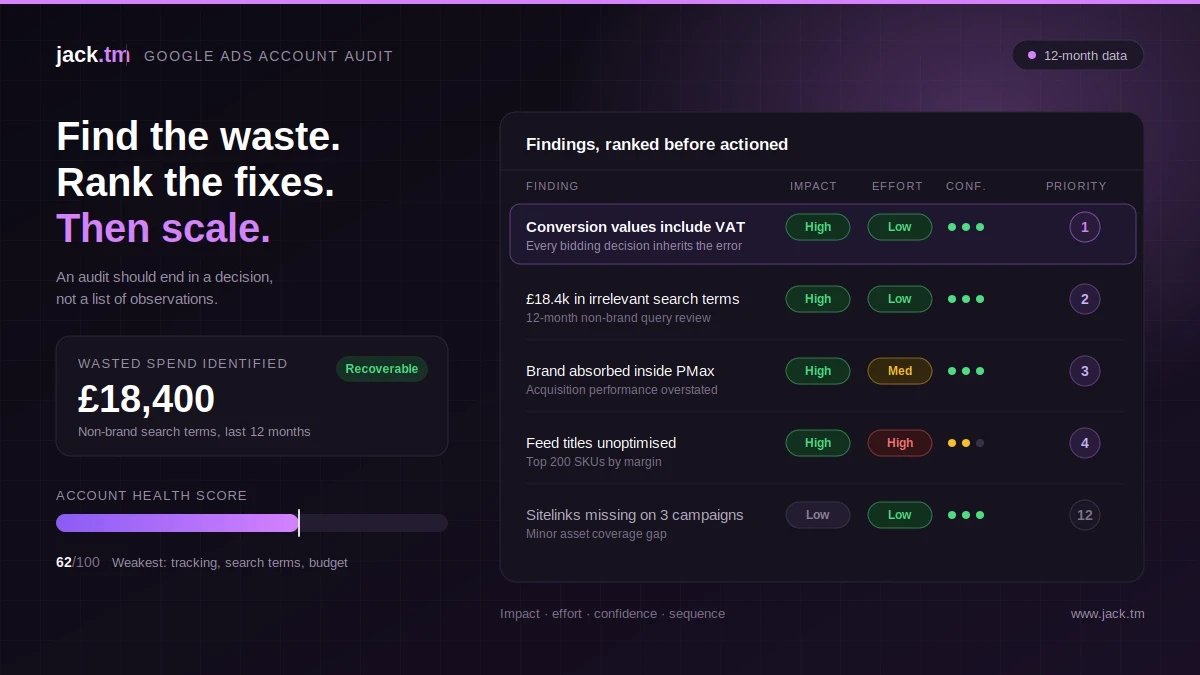
Almost every serious problem found in a Google Ads audit traces back to the same place.
The account is not badly managed. It is managed accurately towards an inaccurate signal.
Smart Bidding does exactly what it is told. If conversion values include VAT and delivery, it will overvalue high-shipping orders. If a newsletter signup is set as a primary conversion, it will buy newsletter signups. If a lead form fires twice, it will overpay for whichever traffic triggers the duplicate.
None of that shows up as an obvious error. It shows up as a campaign that looks efficient and a business that is not growing.
This is why conversion tracking comes first in an audit, and why nothing else in the account should be judged until it has been validated.
The Gap Between Real and Tracked Conversions
Even a well-built setup does not capture everything.
Browser restrictions on cookie lifespans, third-party cookie blocking, ad blockers, cross-device journeys and consent refusal all reduce what can be observed directly. Industry estimates for the shortfall vary widely by sector and geography, but the direction is consistent: standard tag-only tracking now captures materially less than the true total.
The point of an audit is not to reach perfect measurement. It is to know:
What is being counted What is being missed What is being counted twice What is being counted that should not be How much confidence each figure deserves
Configuration: Checks 1 to 5
1. Which conversion actions are primary
Only actions that represent real commercial outcomes should be set as primary, because primary actions are what bidding optimises towards.
Check for primary status on:
Newsletter signups Phone number clicks with no call duration threshold PDF or brochure downloads Contact page views Scroll or engagement events Add to basket
Secondary actions are still reported and still useful for analysis. They simply should not be steering the budget.
2. Duplicate counting
Duplicates are common and rarely noticed.
Check:
Whether the same event is tracked by both a Google Ads tag and a GA4 import Whether a thank-you page and a form-submit event both fire Whether the tag fires again on page refresh or back-button navigation Whether "count every" is used where "count one" is appropriate Whether multiple containers or historic hard-coded tags are still live
A quick test: compare platform conversions against actual orders or CRM records for the same period. A consistent ratio above one is usually a duplication issue.
3. Counting settings
For ecommerce, every purchase should usually count. For lead generation, one conversion per click is usually correct, unless repeat enquiries are genuinely separate opportunities.
Check the count setting on every action, not just the main one.
4. Conversion windows
Check:
Click-through window length against the real sales cycle View-through window and whether view-through conversions are included in bidding Engaged-view settings for video Whether a short window is truncating long consideration cycles Whether a long window is claiming credit for unrelated later activity
5. Attribution model
Two models remain available, data-driven and last click, after the older rule-based models were retired. Data-driven attribution is the default for new conversion actions.
Check which model is applied, whether it is consistent across actions, and whether a model change coincides with an apparent performance shift. Changing attribution changes historical comparisons, and that is frequently mistaken for a real performance change.
Data Quality: Checks 6 to 9
6. Value accuracy
For ecommerce, check whether transaction values:
Exclude VAT where appropriate Exclude delivery charges Reflect discount codes actually applied Reflect the correct currency Exclude test transactions
A revenue figure inflated by VAT and delivery does not just misreport. It actively biases bidding towards high-shipping, low-margin orders.
7. Refunds and cancellations
Check whether refunds, cancellations and returned orders are adjusted. In categories with high return rates, unadjusted revenue can make the worst-performing product lines look like the best.
8. Lead values
For lead generation, a flat value on every lead tells bidding that every enquiry is equal. It is not.
Check whether:
Different form types carry different values Values reflect close rate and average contract value Qualified and unqualified leads are distinguished Spam and duplicate submissions are excluded
9. Tag firing conditions
Check:
Whether the tag fires on the correct trigger, not on page load Whether it fires on failed form submissions Whether it fires for internal traffic, staff or test users Whether it fires on all conversion paths, including phone, chat and checkout variants Whether any conversion path is not tracked at all
Missing paths are as damaging as duplicated ones, and much harder to spot.
Recovery Layers: Checks 10 to 12
10. Enhanced conversions
Enhanced conversions use hashed first-party data, such as email addresses provided at checkout or on a form, to match conversions that cookie-based tracking missed.
Check:
Whether it is enabled at all Whether it is enabled for every action where user data is collected Whether the data is being passed correctly after any tag or platform change Match rate reporting Whether the privacy policy and consent flow support it
11. Consent mode
Consent Mode v2 has been a requirement for advertisers serving the EEA and UK since March 2024, and its role has since become more central to whether analytics data flows into Google Ads correctly.
Check:
Whether basic or advanced consent mode is implemented Whether consent signals are actually passing, not just configured Consent rates, and whether the banner design is suppressing them unnecessarily Whether modelling thresholds are being met Whether the setup survived the most recent tag or analytics changes
12. Server-side tagging and offline imports
For higher-spend accounts, check whether server-side tagging is in place or justified.
For lead generation, check whether CRM outcomes are imported. Optimising towards form submissions when the business cares about closed sales is the single most common structural error in lead generation accounts.
Business Truth: Checks 13 to 15
13. Reconciliation
Compare, for the same period and the same definition:
Google Ads conversions GA4 conversions Backend orders or CRM records Finance revenue
Small variances are expected. Large or inconsistent gaps need explanation before any conclusion is drawn from the data.
Document the variance. An audit that says "platform conversions run 12% above backend orders, consistently" is far more useful than one that says the tracking looks fine.
14. Lead quality feedback
Check whether the account has any visibility of what happens after the lead.
Lead to opportunity rate by campaign Lead to sale rate by keyword or campaign Disqualification reasons Average contract value by source
Without this, cost per lead is the only available metric, and it rewards the cheapest traffic rather than the best.
15. Segmentation of conversion types
Check whether reported conversions can be broken down by:
New versus returning customers Product category or service line Geography Device Brand versus non-brand
A single blended conversion count hides most of what matters commercially.
What Changed Recently
Two developments are worth checking against any setup built before this year.
Google restructured parts of GA4 in April 2026, including default event definitions, the way hashed data passes back for enhanced conversions, and the reporting of attribution. Setups that were configured correctly beforehand may not be passing data correctly now without reconfiguration.
Consent Mode v2 also became a firmer requirement for analytics data flowing accurately into Google Ads conversion tracking in the EEA and UK, with tighter modelling thresholds applied more broadly.
If an account has imported GA4 conversions and nobody has reviewed the setup since the spring, that is a check worth running before anything else.
Scoring Confidence
Not every conversion figure deserves equal trust. Attach a confidence rating to each data source.
Data source | Reliability | Notes |
Backend order data | High | Reconciles with finance |
Google Ads purchases | High | Values corrected, deduplicated |
CRM-confirmed sales | High | Imported weekly |
GA4 imported events | Medium | Reconfigured after April update |
Modelled conversions | Medium | Threshold-dependent |
View-through conversions | Low | Cannot be validated independently |
Findings built on low-confidence data should be labelled as estimates, not conclusions.
Fix Order
Immediately Correct primary and secondary designations, remove duplicates, fix values that include VAT or delivery, exclude internal traffic.
Within two weeks Enable enhanced conversions everywhere applicable, verify consent mode is passing signals, correct counting settings and windows.
Within a month Import CRM outcomes, apply differentiated lead values, build a reconciliation report that runs monthly.
Ongoing Re-verify after every website release, tag change, platform update or checkout change. Tracking does not stay fixed.
Common Mistakes
Optimising before validating Any bidding or budget change made on inaccurate data amplifies the error.
Treating all conversions as equal A flat value across every action tells the algorithm nothing about commercial priority.
Setting every action as primary Bidding will chase the cheapest available action, which is rarely the valuable one.
Assuming tracking still works Most tracking breaks silently, during a site release nobody flagged to the marketing team.
Ignoring the backend The platform is a measurement tool, not the source of truth. Finance is.
Removing view-through conversions entirely They have some value in some contexts. The mistake is including them in bidding without validation, not acknowledging they exist.
How AI Can Support a Tracking Audit
Reviewing conversion actions, counting settings, tag configurations, value logic and reconciliation gaps across a large account is slow, repetitive work, and the errors are individually small.
AI can process:
Conversion action configuration at scale Value and revenue anomalies Duplicate patterns across sources Gaps between platform and backend data Campaigns optimising towards low-value actions
GoogleAdsAudits.com reviews account structure, tracking, targeting, bidding, creative and channel mix, then produces a prioritised action plan positioning each recommendation by impact, effort and confidence.
The verification of what is actually true still requires access to the business data and someone willing to check it.
Final Thoughts
Conversion tracking is not a technical detail that sits underneath the account. It is the instruction set the account is following.
Before any structural change, bid adjustment or budget reallocation, answer three questions:
Is the account counting the right things? Is it counting them once, and at the right value? Does the total reconcile with what the business actually banked?
Until those three are answered, everything else is an opinion with a decimal point.
Build a personalised Google Ads action plan that identifies wasted spend, scalable opportunities and the fixes your team should prioritise next.
Frequently Asked Questions
How accurate is Google Ads conversion tracking?
Less accurate than most advertisers assume. Cookie restrictions, ad blockers, cross-device journeys and consent refusal all reduce what can be observed directly. Enhanced conversions, consent mode and offline imports recover part of the gap, but reconciliation against backend data is the only way to know the real position.
Why are Google Ads conversions higher than my actual orders?
Usually duplicate counting, an incorrect count setting, a tag firing on page load rather than on the transaction, or attribution differences between platforms. Check duplicates first.
Should GA4 conversions be imported into Google Ads?
They can be, but direct Google Ads tags generally provide a cleaner signal for bidding. If both are used, make sure the same action is not counted twice.
What should be a primary conversion?
Only actions with genuine commercial value. Everything else can remain secondary for reporting purposes without influencing bidding.
Do I need enhanced conversions?
If user data is collected at the point of conversion, yes. It recovers conversions that cookie-based tracking misses, and it takes relatively little work to implement.
How often should conversion tracking be checked?
At minimum after every website release, checkout change, tag update or analytics platform change, plus a scheduled reconciliation each month.
Should view-through conversions be included in bidding?
Only where their incremental value has been validated. Included unchecked, they inflate reported performance on upper-funnel activity.
What is the single most valuable tracking improvement for lead generation?
Importing CRM outcomes, so the account optimises towards sales rather than form submissions.
AUTHOR BIO
Jack Felstead is an award-winning Paid Media, AI and Digital Growth Consultant with 17 years of experience helping businesses improve customer acquisition, advertising efficiency, revenue and profit.