How to Audit a Performance Max Campaign
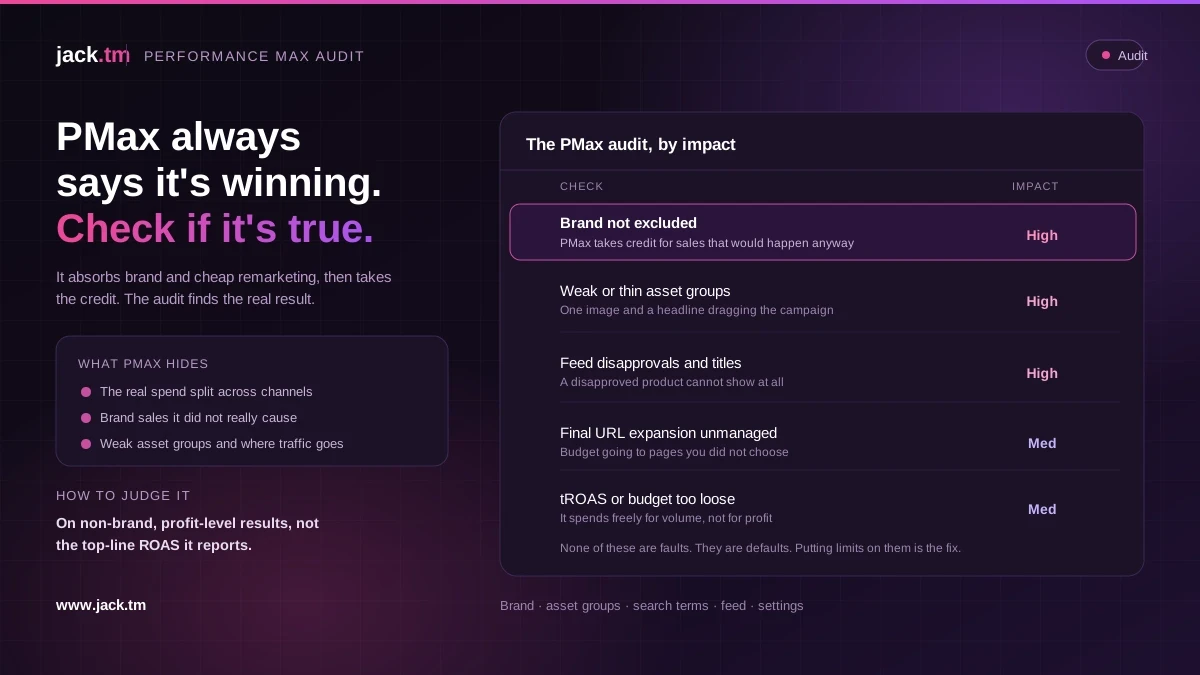
Performance Max is the hardest campaign type to audit, which is exactly why it needs auditing. It runs across Search, Shopping, Display, YouTube, Gmail and Maps from one budget, and Google decides the split. You get far less visibility than a normal campaign, and that is where waste hides.
Most PMax reviews stop at the top-line ROAS and move on. That number flatters almost every PMax campaign, because PMax quietly absorbs brand searches and cheap remarketing that would have converted anyway. Strip those out and the real picture is often very different.
Here is how to audit a Performance Max campaign properly, in the order that finds the money fastest.
Start by separating brand from everything else
This is the single most important PMax check, and the one most audits skip.
Left alone, PMax will serve on your brand terms and take the credit for sales that would have happened without a single paid click. The reported ROAS looks great. The incremental value is much smaller.
Check whether brand traffic is being excluded. The cleaner route is brand exclusions applied at the campaign level, or a separate brand campaign that holds those terms so PMax is left with genuine prospecting. If neither is in place, assume a chunk of the reported performance is brand cannibalisation, and judge the campaign on its non-brand numbers.
Look inside the asset groups
PMax hides a lot, but asset groups are where you can still see.
Open each asset group and check three things. Are the assets strong, or is this a thin group with one image and a headline doing all the work? Is the audience signal sensible, or is it empty or pointing at the wrong people? And is Final URL expansion sending traffic to pages you did not choose?
A single weak asset group can drag a whole campaign. You often cannot see the spend split cleanly, but you can see which groups have the assets and signals to deserve budget, and which are starving the campaign of quality.
Check the Search terms and the channel mix
PMax gives you more visibility than it used to. Use it.
The search terms insight shows the queries PMax matched to. Read it for the same thing you would in a search audit: irrelevant terms, brand bleed, and junk soaking up budget. Then look at where spend is going across the channels. If a campaign meant for prospecting is mostly serving cheap Display and remarketing, the reported efficiency is not what it seems.
Check the feed, if it is a Shopping-led PMax
For ecommerce, PMax leans heavily on the product feed, so a feed problem is a PMax problem.
Check for disapprovals first, because a disapproved product cannot show no matter how good the campaign is. Then check titles, because PMax matches on them, and website titles rarely match how people search. Then check that real margin is feeding in, so bidding chases profit, not just high-revenue, low-margin lines.
Check the settings that quietly inflate spend
A few PMax settings cause most of the overspend.
The tROAS target: set too low, PMax spends freely for volume. Final URL expansion on with no page exclusions sends budget to pages you did not intend. And a shared or uncapped budget lets PMax drain spend from better campaigns. None of these are faults, they are defaults. Putting limits on them is the fix.
Then judge it on profit, not reported ROAS
The point of the audit is one honest question: is this campaign making money that would not have come anyway?
Pull the non-brand numbers. Weight them by real margin, not revenue. Compare against what the account did before PMax, or against a period with brand stripped out. If the incremental, profit-level result holds up, scale it. If it only looks good because of brand and remarketing, restructure it before you give it another pound.
PMax can be an excellent campaign type. It just does not audit itself, and left on defaults it will always tell you it is winning. The audit is how you find out whether that is true.
FAQs
What is the biggest Performance Max mistake? Letting PMax serve on brand terms without exclusions. It inflates the reported ROAS with sales that would have happened anyway.
Can you see where Performance Max spends? Partly. You can see search terms, asset group assets and some channel insight, but not a full clean spend split. You audit what you can see and infer the rest.
Should I use brand exclusions on PMax? In most accounts, yes. It stops PMax taking credit for brand demand and leaves it to do genuine prospecting, which is what it is for.
How often should I audit a PMax campaign? Monthly as a light check, fully each quarter, and always after a feed change or a big shift in reported performance.
Is Performance Max worth running? Often, yes, once brand is excluded, the feed is clean and it is judged on profit. The problem is not PMax, it is running it on defaults and trusting the top-line number.