How to Audit Your Google Ads Bidding Strategy
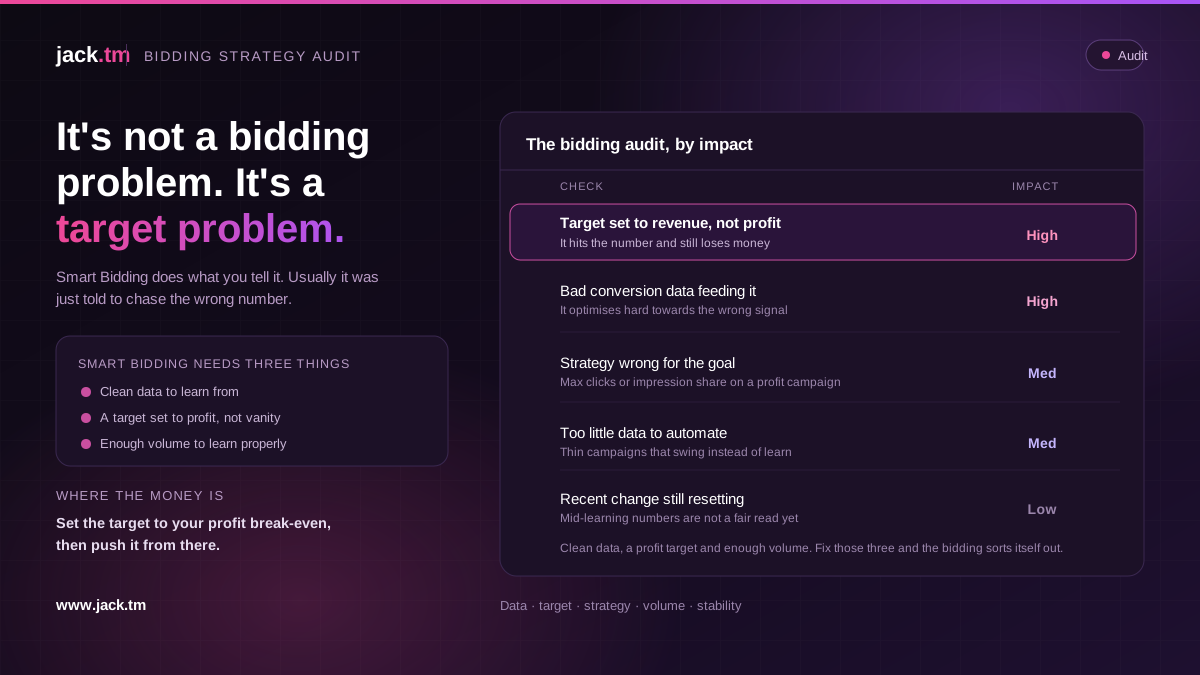
Most accounts do not have a bidding problem. They have a target problem. The bid strategy is doing exactly what it was told; it was just told the wrong thing.
Smart Bidding is only as good as three things: the data it learns from, the target you set, and the structure you point it at. Get those right and automated bidding is hard to beat. Get any one wrong and it will confidently spend your budget on the wrong outcome.
A bidding audit checks all three. Here it is, in order.
First, check the data it learns from
Before you touch the bid strategy, check what it is optimising towards. This is the step most people skip, and it makes the rest pointless.
If the conversion tracking is feeding soft actions, double counting, or revenue with no margin, the bid strategy is chasing bad signals. No target change fixes that. So confirm the tracking is clean first: the right primary actions, one count per sale, and real value passed. Only then does the bid strategy have something honest to optimise.
If the data is wrong, stop here and fix tracking. Everything below assumes the data is sound.
Check the target is set to profit, not vanity
This is where most of the money is.
A tROAS set too low tells Google to spend freely for volume. A tCPA set too high does the same. Both hit their target and still lose money, because the target was never tied to profit in the first place.
Work out the ROAS or CPA you actually need to make money, after cost of goods, returns and fees. Then compare it to the target in the account. If the account is running a 3x tROAS when it needs 4.5x to break even on profit, the bidding is working perfectly towards a loss. Reset the target to the profit break-even, then push it from there.
Check the strategy matches the goal
The bid strategy should match what the campaign is actually for.
Maximise conversions with no target will spend the whole budget chasing volume at any cost. Maximise clicks is almost never right for a performance campaign. Target impression share is for visibility, not profit, and quietly bids up cost to hold a position. Match the strategy to the job: a value or ROAS goal for ecommerce, a CPA or value goal for lead gen, and manual or visibility strategies only where they genuinely fit.
Check there is enough data to automate
Smart Bidding needs volume to learn. Starve it and it guesses.
Look at conversions per campaign over the last 30 days. A campaign with a handful of conversions a month does not give the system enough to optimise well, and it will swing. The fix is usually structural: consolidate thin campaigns so the data pools, rather than splitting one goal across five tiny campaigns that each learn from almost nothing.
Check for recent changes that reset learning
Every major change restarts the learning period, and performance wobbles while it settles.
Look at the change history. A target moved last week, a new strategy applied, a budget doubled; any of these means the current numbers are mid-reset and not yet a fair read. Note them, and do not judge a strategy you only changed a few days ago. Change one thing, then give it time before changing the next.
Then judge it on profit over a fair window
The audit ends with the same question every audit should: is this making money?
Pull a clean window with no learning resets and no attribution changes. Weight the result by real margin. If the strategy is hitting a profit-level target with enough data behind it, leave it alone and raise the target gently to push for more. If it is hitting a vanity target, or starving on thin data, that is your fix, and it is almost always worth more than any keyword change.
Good bidding is not about clever strategies. It is clean data, a profit target, and enough volume to learn. Audit those three and the bidding usually sorts itself out.
FAQs
What is the most common bidding mistake?
A target set to revenue or volume, not profit. The strategy hits its number and still loses money, because the number was wrong.
How much data does Smart Bidding need?
More is better, but as a rough guide, very low conversion volume per campaign leads to unstable bidding. If campaigns are thin, consolidate so the data pools.
Should I use tROAS or tCPA?
Value-based goals like tROAS suit ecommerce where order values vary. CPA goals suit lead gen where each conversion is worth roughly the same. Match it to how value works in your business.
Why did performance drop after I changed the bid target?
Every major change restarts the learning period. Expect a wobble for a week or two, and do not stack more changes on top while it settles.
Can automated bidding bid to profit?
Yes, if you feed it real value or margin and set the target to your profit break-even. On revenue alone, it chases high-revenue, low-margin sales.