How to Audit Your Negative Keywords in Google Ads
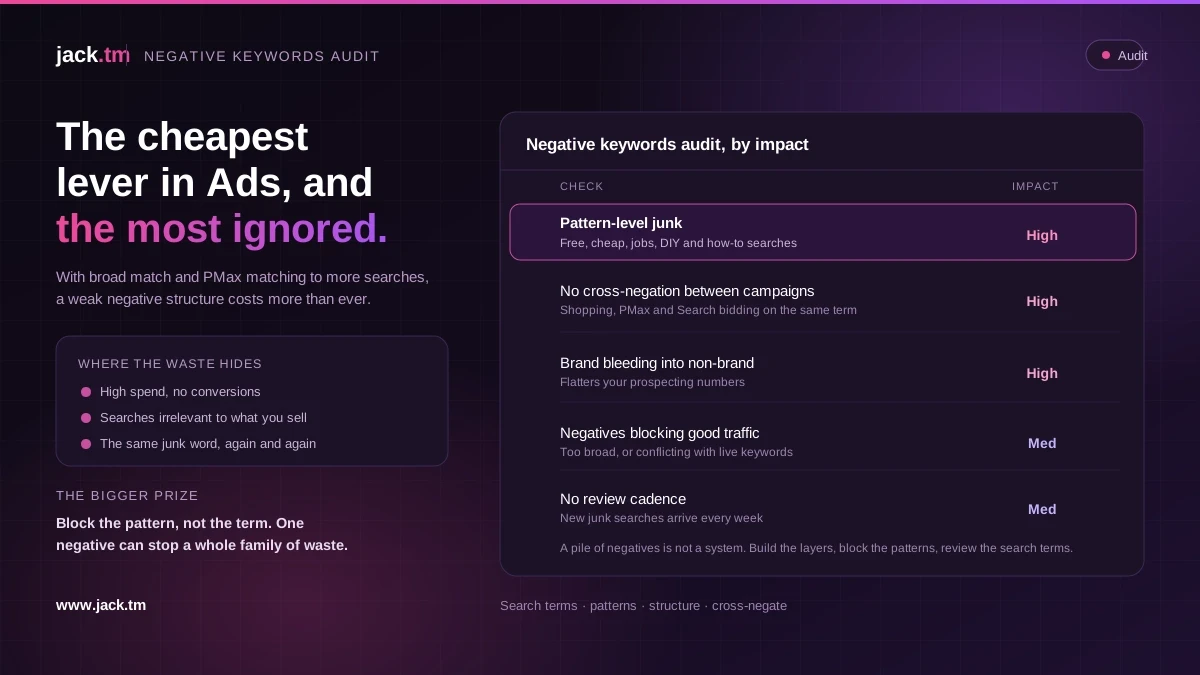
Negative keywords are the cheapest lever in Google Ads, and the most neglected. Every account loses money to searches it should never have paid for, and in most accounts no one has looked at the negatives properly in months. An audit finds that waste fast.
With broad match and Performance Max matching to more searches than ever, a weak negative structure is more expensive than it used to be. Here is how to audit it, in order.
Start in the search terms report
This is where the evidence is. Pull the search terms report over a long window, twelve months if you can, not thirty days, and sort by cost.
You are looking for three things: searches with high spend and no conversions, searches that are obviously irrelevant to what you sell, and the same junk word or phrase showing up again and again. The irrelevant terms are the first wins. The repeated patterns are the bigger prize, because one well-placed negative can block a whole family of wasted searches at once.
Check what negatives already exist
Before adding anything, look at what is there. Most accounts have negatives scattered across campaigns with no logic, added in a panic over the years and never organised.
Check for negatives that are too broad and may be blocking good traffic, negatives that conflict with keywords you are actively bidding on, and old negative lists applied to some campaigns but not others. A negative that blocks a converting search is as expensive as a missing one; it just hides the loss instead of showing it.
Look for the common waste patterns
Some waste shows up in almost every account. Free, cheap, jobs, DIY, and how-to searches, for a business that sells, not teaches. Competitor and other-brand names you do not want to pay for. Locations you do not serve. And informational searches where the person is researching, not buying.
Each of these is a pattern, not a single term. The job of the audit is to spot the pattern and block it once, rather than chasing individual terms one at a time forever.
Check the structure, not just the list
A pile of negatives is not a system. A good account has layers: account-level negative lists for universal junk, shared lists applied by campaign type, and campaign-level negatives for the specific jobs of each campaign.
Two structural checks matter most. Are brand terms kept out of non-brand campaigns, so your prospecting numbers are clean? And are your campaigns cross-negated where they should be, so Shopping, PMax and Search are not bidding against each other for the same search? Structure is where the real control lives.
Then quantify it and act
End the audit with a number: this much spend, this period, went to searches a sensible negative structure would have blocked. That figure is usually the fastest saving in the account, and it makes the case for the work on its own.
Then build the layers, add the pattern-level negatives first, and set a cadence to review the search terms regularly, because new junk arrives every week. Negatives are not a one-off job. They are the ongoing discipline that keeps waste out.
FAQs
What is a negative keywords audit?
A review of the searches your ads are matching to, the negatives already in place, and the structure holding them, to find and block spend on searches that will never convert.
How far back should I look at search terms?
As far as the data allows, ideally twelve months, not thirty days. A short window hides seasonal and infrequent waste.
What are the most common wasted searches?
Free, cheap, jobs, DIY and how-to terms for businesses that sell rather than teach, plus competitor names, locations you do not serve, and research-stage searches.
Can negative keywords block good traffic?
Yes. A negative that is too broad, or conflicts with a keyword you bid on, can block converting searches. That is why the audit checks existing negatives, not just missing ones.
How often should I review negatives?
Regularly, because new junk searches arrive every week. A one-off clean-up drifts out of date fast.