How to Audit Impression Share in Google Ads
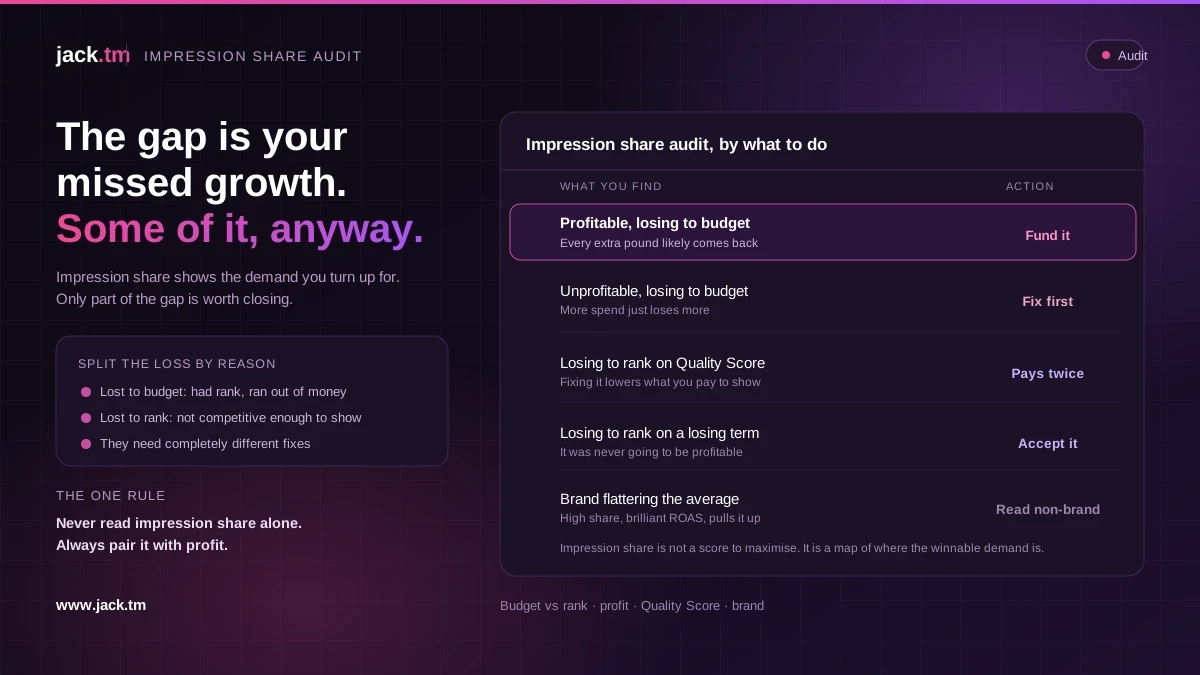
Impression share is one of the most useful numbers in Google Ads and one of the most misread. It tells you how much of the available demand you are actually showing up for. The gap, the share you are losing, is where your missed growth sits. But only some of that gap is worth closing, and the audit is about telling which.
Here is how to audit impression share properly, and turn it into a decision rather than a vanity chase.
Split lost impression share into budget and rank
This is the whole game, and the step most people skip. Google splits lost impression share into two reasons, and they mean completely different things.
Lost to budget means you had the rank to show, but ran out of money. The demand was there and winnable; you just could not afford all of it. Lost to rank means you were not competitive enough to show, usually down to bids, Quality Score or relevance. One is a budget decision, the other is an account-quality problem. Treat them the same and you will throw money at the wrong one.
Find the profitable budget-limited campaigns
Lost impression share to budget is only good news when the campaign is profitable. A campaign hitting its ROAS or CPA target and losing a big chunk of impressions to budget is the clearest growth signal in the account: every extra pound is likely to come back at the same return.
So cross-reference the two. A profitable campaign losing 40 percent of impressions to budget is a case for more spend. An unprofitable campaign losing the same share is a case for fixing it first, not funding it. The audit pairs lost impression share with performance, never reads it alone.
Diagnose the rank losses
Lost impression share to rank is a quality problem, and it has a handful of usual causes. Bids too low for the auction. Weak Quality Score from poor ad relevance or landing page experience. Thin or poorly matched ad copy. Or simply a very competitive term where you are rightly choosing not to compete.
The audit’s job is to separate the rank losses worth fixing from the ones worth accepting. Lifting Quality Score lowers what you pay to show, so it is almost always worth chasing. Bidding harder on a term that was never going to be profitable is not.
Watch for the brand trap
Brand campaigns usually show very high impression share and a brilliant ROAS, and they pull the account average up. Left in the blended number, they make your impression share look healthier than it is on the traffic that actually matters.
Always read impression share for brand and non-brand separately. The non-brand figure is the one that tells you how much new demand you are capturing, and that is where growth comes from.
Then turn it into a plan
End the audit with a short, ranked list. The profitable budget-limited campaigns worth funding, in order of the return on the extra spend. The rank losses worth fixing, Quality Score first because it pays twice. And the gaps worth leaving alone, because not all missed impressions are missed profit.
Impression share is not a score to maximise. It is a map of where the winnable demand is. Read it against profit, split it by reason, and it tells you exactly where the next pound should go.
FAQs
What is a good impression share in Google Ads?
There is no universal target. A high figure on unprofitable traffic is bad; a lower figure on profitable, budget-limited campaigns points to real growth. Read it against performance, not as a score.
What is the difference between lost impression share to budget and to rank?
Budget means you had the rank but ran out of money. Rank means you were not competitive enough to show, usually bids, Quality Score or relevance. They need different fixes.
Should I always try to increase impression share?
No. Only where the extra impressions are likely to be profitable. Chasing impression share on losing traffic just spends more to lose more.
Why separate brand and non-brand impression share?
Brand usually shows very high share and flatters the average. The non-brand figure tells you how much new demand you are actually capturing.
How do I fix lost impression share to rank?
Start with Quality Score, through better ad relevance and landing pages, because it lowers your cost to show. Raise bids only where the term can be profitable.