Quality Score: What It Really Tells You in an Audit
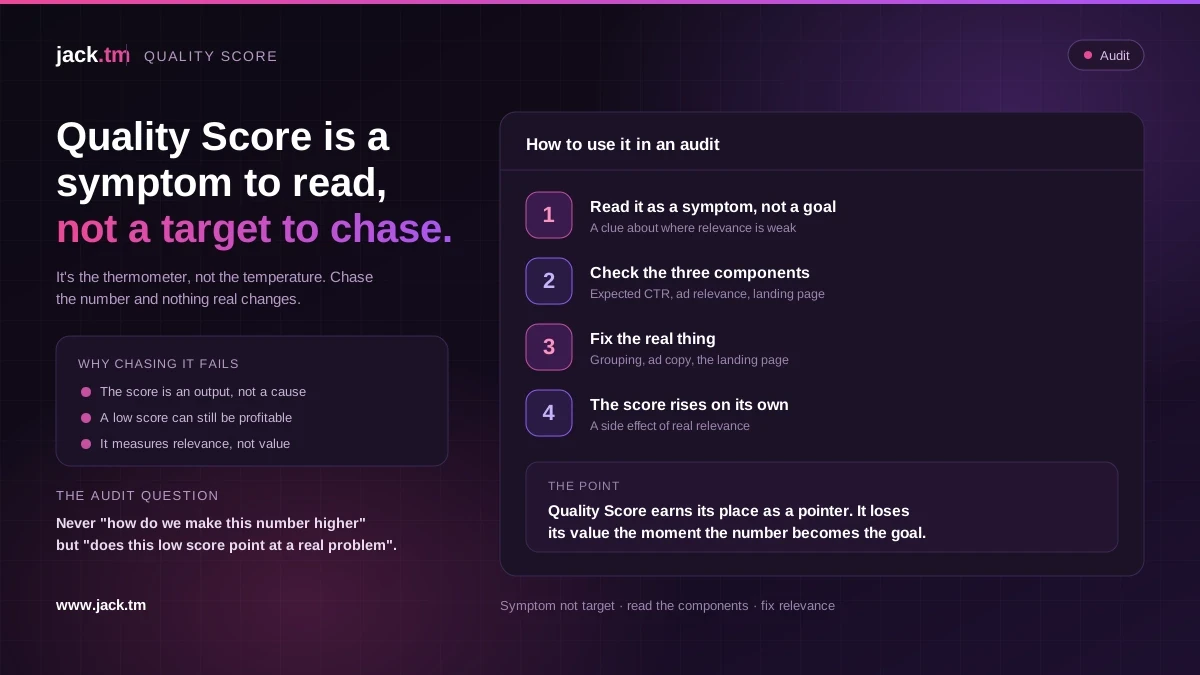
Quality Score is one of the most misunderstood numbers in Google Ads. People treat it as a target to chase, a score to grind up from 6 to 10 as if the number itself were the prize. It is not. In an audit, Quality Score is a symptom, a diagnostic reading that points you to problems, not a goal to optimise directly. Used that way it is genuinely useful. Chased directly it wastes time. Here is what it actually tells you and how to read it properly.
What Quality Score actually is
Quality Score is Google's rating, from 1 to 10, of how relevant and useful your ad and landing page are for a given keyword, based on three things: expected click-through rate, ad relevance, and landing page experience. A higher score means Google thinks you are a better match for that search, which tends to earn you better ad positions at a lower cost per click.
That last part is why people care, and why they get it wrong. They see that a higher Quality Score means cheaper clicks and decide to chase the score. But Quality Score is a reflection of relevance, not a cause of it. You cannot improve it by wanting a bigger number. You improve it by fixing the underlying relevance it is measuring, at which point the score follows. The number is the thermometer, not the temperature.
Why chasing the number is the wrong move
The reason chasing Quality Score directly is a mistake is that the score is an output. It summarises how relevant Google finds your ad and page. Trying to lift the summary without improving the thing it summarises is like trying to raise your reflection in a mirror. Nothing real changes.
Worse, obsessing over the score can send you optimising for Google's rating instead of for your own profit. A keyword can have a low Quality Score and still make money, and a high one and lose it, because Quality Score says nothing about whether the traffic is profitable. It measures relevance, not value. So an audit never treats Quality Score as the goal. It treats it as a clue about where relevance is weak, then checks whether fixing that relevance is actually worth doing for the business.
How to read it in an audit
Used as a diagnostic, Quality Score is a quick way to find where an account is out of alignment. Look for keywords with real spend and a low score, and then read the three components to see why. A low expected click-through rate suggests the ad is not compelling for that search. Low ad relevance suggests the keyword and the ad copy do not match well, often a sign the keyword is in the wrong ad group. A low landing page experience points at the page the ad sends people to.
Each component points somewhere specific, which is what makes Quality Score useful in an audit. It is a map of where the mismatches are. A keyword stuffed into an ad group full of unrelated keywords will show low ad relevance, because the one ad cannot speak to all of them. That tells you the structure is too loose. A low landing page score tells you to look past the account at the page. The score itself is just the headline; the components are the actual diagnosis.
What to do with what it tells you
Once the components point you to the problem, you fix the real thing, not the number. If ad relevance is low because unrelated keywords share an ad group, tighten the grouping so the ad can match. If expected click-through rate is low, the ad copy needs to speak more directly to the search. If landing page experience is low, the page needs work, speed, relevance, clarity. Do those and the Quality Score rises on its own, as a side effect of the account genuinely becoming more relevant.
And sometimes the right answer is to do nothing. A keyword with a low Quality Score that still brings in profitable customers does not necessarily need fixing. The audit question is never "how do we make this number higher" but "does this low score point at a real problem worth solving". Quality Score earns its place in an audit as a pointer, a fast way to find weak spots. It loses all its value the moment you start treating the number as the point.
FAQs
What is Quality Score? Google's 1 to 10 rating of how relevant and useful your ad and landing page are for a keyword, based on expected click-through rate, ad relevance and landing page experience. A higher score tends to earn better positions at a lower cost per click.
Should I try to improve my Quality Score? Not directly. Quality Score is an output that reflects relevance, so you improve it by fixing the underlying relevance, better ad-to-keyword match, stronger ads, a better landing page, and the score follows. Chasing the number itself achieves nothing.
Can a low Quality Score keyword still be worth keeping? Yes. Quality Score measures relevance, not profit. A keyword can have a low score and still bring in profitable customers. The audit question is whether the low score points at a real problem, not whether the number is high.
How do I use Quality Score in an audit? As a diagnostic. Find keywords with real spend and a low score, then read the three components. Each one points somewhere specific, ad relevance to grouping and copy, landing page experience to the page, so the score maps where the mismatches are.
Does Quality Score affect my costs? A higher Quality Score tends to earn better ad positions at a lower cost per click, which is why it matters. But it is the relevance behind the score that you improve, not the score itself, and relevance is not the same as profitability.