Shopping Feed Audit: The Part of Your Account You Can't See
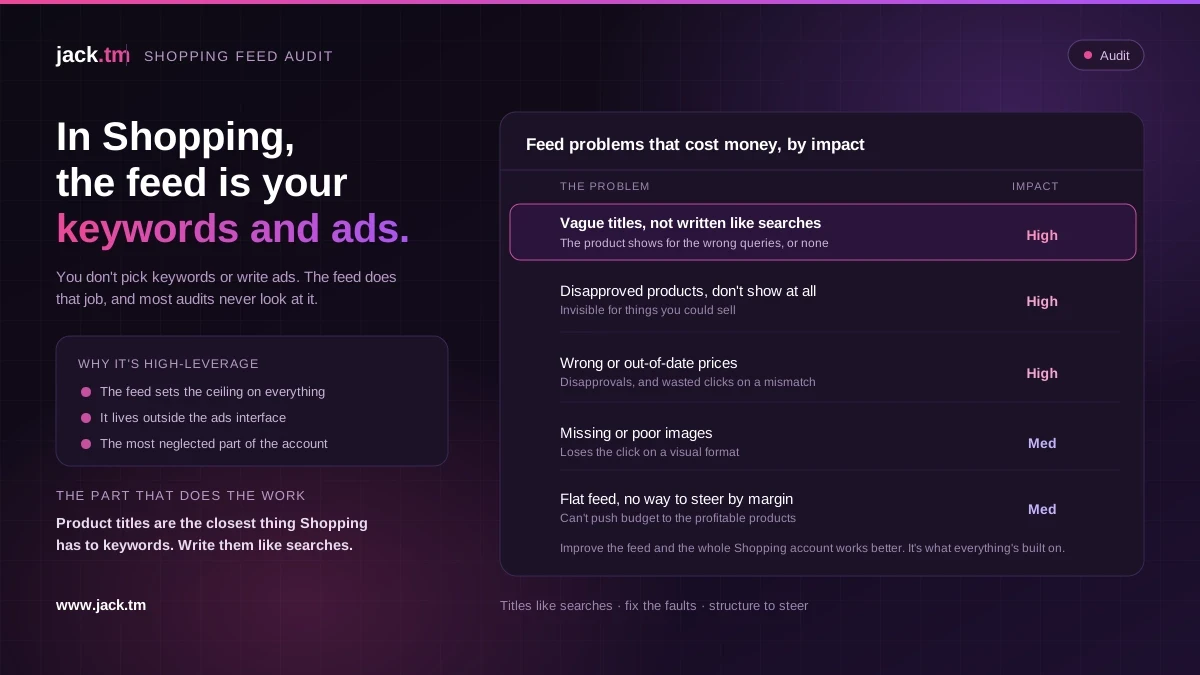
For an ecommerce account, the product feed is the most important thing most audits never look at. In Shopping and Performance Max, you do not write ads or choose keywords in the usual way. The feed does that job: it decides what you show for, what the ad looks like, and much of how the bidding understands your products. A weak feed quietly caps everything built on top of it, and because it lives in Merchant Centre rather than the ads account, it is easy to ignore. Here is how to audit it and why it matters so much.
In Shopping, the feed is the account
This is the thing to understand first. In a search campaign, you pick keywords and write ads. In Shopping, you do neither directly. Google reads your product feed, the file describing every product, its title, description, type, price, image and more, and uses it to decide which searches to show each product for and what the listing looks like. The feed is your keywords and your ads rolled into one.
That means the quality of the feed sets the ceiling on everything. The best bidding in the world cannot show a product for the right searches if the feed does not describe it well enough for Google to understand it. A feed audit is really an audit of the raw material the whole Shopping account is built from, and on most accounts it is the single most neglected and highest-leverage thing to look at, precisely because it sits outside the ads interface where everyone spends their time.
Titles and types do the heavy lifting
The parts of the feed that matter most are the ones that tell Google what a product actually is. Product titles do an enormous amount of work, because they are the closest thing Shopping has to keywords. A title that reads like the words people actually search, the brand, the product, the key attributes they look for, helps Google match it to the right queries. A vague or internal-code title leaves the product showing for the wrong searches or not at all.
Product type and category matter for the same reason: they help Google place the product correctly and bid sensibly on it. A feed audit reads the titles and types the way Google does and asks whether a stranger, or a machine, could tell from them what each product is and who would want it. Many feeds are full of titles written for an internal system, not a searcher, and fixing them is often the biggest win in the whole account, because it changes which searches every product can appear for.
The quiet feed problems that cost money
Beyond the titles, a feed audit looks for the faults that silently drag performance down. Disapproved or rejected products, which simply do not show at all, so you are invisible for things you could sell. Missing or poor-quality images, which lose the click on a visual format. Wrong or out-of-date prices, which cause disapprovals and waste clicks when the price on the page does not match. Products missing key attributes the feed could include, leaving Google guessing.
Each of these is money lost quietly, because none of it shows up as a dramatic number in the ads account. You just show for fewer things, or worse things, than you should, and the spend that does go out works less hard. A feed audit is partly a health check: how many products are actually eligible to show, how many are held back by a fixable fault, and how much of the range is effectively invisible because of a feed problem nobody noticed.
Is the feed structured so you can steer?
The last thing a feed audit checks is whether the feed gives you any control. A flat feed with no useful structure forces you to treat every product the same, which, as with bidding, means the same approach for products with completely different margins and priorities. A well-structured feed, with custom labels and clear groupings, lets you separate products by margin, by seasonality, by bestseller status, by whatever actually matters to the business, so the account can bid and budget deliberately rather than treating the whole catalogue as one lump.
This is where the feed audit connects to profitability. Custom labels that mark high-margin or priority products let you steer spend towards them, which a flat feed makes impossible. So a good feed audit does not just check the feed is healthy and well-described, it checks the feed is built to be steered. Get the titles right so products show for the right searches, fix the faults so the range is actually eligible, and structure it so you can push budget where the profit is. Do that and the whole Shopping account works better, because you have improved the thing everything else is built on, instead of fiddling with the bidding on top of a feed that was holding it all back.
FAQs
What is a shopping feed audit? A review of the product feed that powers Google Shopping and Performance Max: the titles, types, images, prices and structure. Because the feed does the job of keywords and ads in Shopping, auditing it checks the raw material the whole account is built on.
Why does the feed matter so much? Because in Shopping you do not pick keywords or write ads directly; the feed decides what you show for and what the listing looks like. The feed's quality sets the ceiling on everything, yet it lives in Merchant Centre and most audits never look at it.
What's the most important part of the feed? Product titles, because they are the closest thing Shopping has to keywords. A title written the way people search helps Google match the product to the right queries. A vague or internal-code title shows the product for the wrong searches or not at all.
What quiet problems does a feed audit catch? Disapproved products that do not show at all, missing or poor images, wrong or out-of-date prices, and missing attributes that leave Google guessing. None shows as a dramatic number in the ads account; you just show for fewer or worse things than you should.
How does feed structure affect profit? A flat feed forces you to treat every product the same. A structured feed with custom labels lets you separate products by margin, season or priority and steer budget towards the profitable ones, which a flat feed makes impossible.