Match Type Audit: Are You Using the Right Ones?
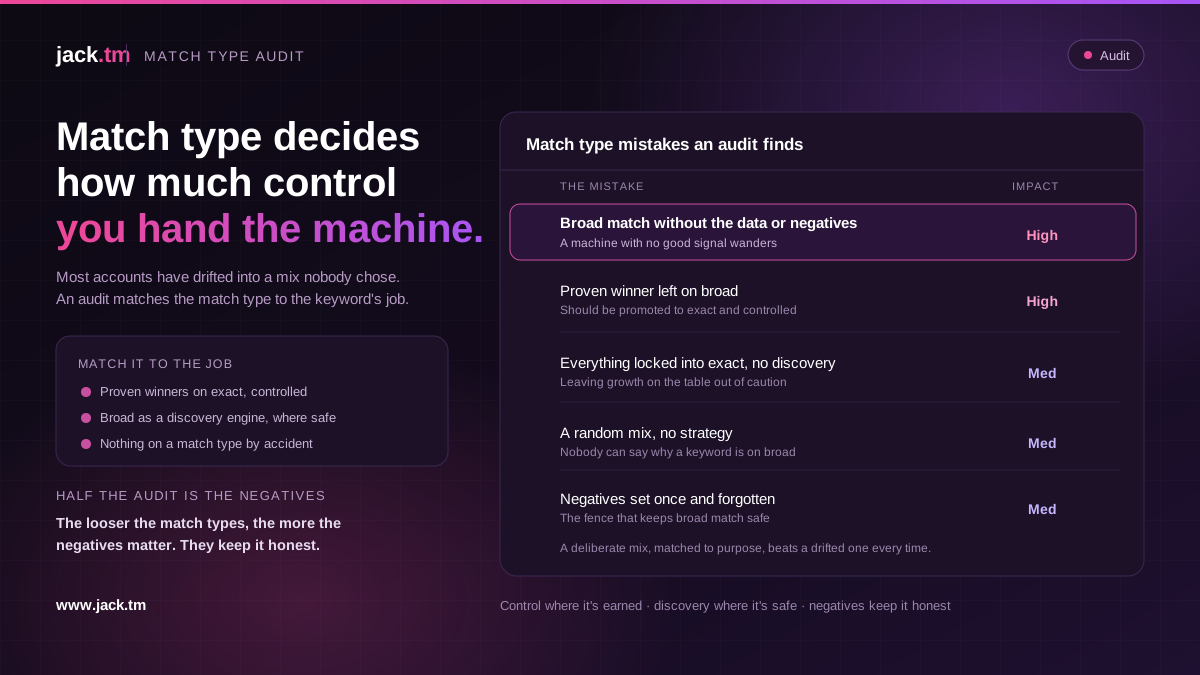
Match types are one of the most consequential settings in a Google Ads account and one of the least examined. Your choice of exact, phrase or broad for each keyword decides how much of your targeting you hand to the machine and how much you keep, and most accounts have drifted into a mix that nobody chose on purpose. A match type audit checks whether your keywords are on the right match types for what they are doing. Here is how to do it and the mistakes it catches.
What match type actually controls
The thing to understand first is that match type is a control dial. At one end, exact match keeps you tight: your ad shows for that specific search and very close variants, so you know what you are paying for and can manage it precisely. At the other end, broad match hands the decision to Google: your keyword can match a wide range of related searches, and the machine, through Smart Bidding, decides which ones are worth a bid. Phrase sits in between.
So choosing a match type is really choosing how much control to keep and how much to delegate. Neither end is right or wrong in itself, they suit different jobs. The mistake is not using broad or using exact, it is using the wrong one for what a keyword is meant to do, or drifting into a mix with no logic behind it. A match type audit is about matching the control to the purpose, keyword by keyword.
The mistakes a match type audit finds
A few patterns show up again and again. The first is broad match running without the conditions it needs: good conversion data, solid tracking and tight negative keyword management. Broad match on a thin or poorly tracked account hands budget to a machine that has no good signal to steer by, so it wanders into irrelevant queries. If the audit finds broad match live on an account that cannot support it, that is a clear problem.
The second is the opposite: an account locked entirely into exact match, so tightly controlled that it never discovers the new queries broad match would find. That is leaving growth on the table out of caution. The third is match types with no strategy behind them, a random mix that grew over the years, where nobody can say why a given keyword is on broad rather than exact. And the fourth is the proven winner left on broad: a search term that clearly converts well, still arriving through broad match, where it should be promoted to its own exact match keyword and controlled properly. A match type audit reads the account and asks, of each keyword, whether its match type fits its job.
Match the match type to the keyword's job
The healthy picture is a deliberate mix, where each keyword's match type reflects what you want from it. Your proven, high-value terms, the searches you know convert, belong on exact match, in tight ad groups with their own ads and landing pages, so you control your best traffic as hard as it deserves. Letting a known winner keep coming through broad match is giving away control of the very traffic you most want to manage.
Broad match, where the account can support it with good data and tight negatives, earns its place as a discovery engine, finding the new queries you would never have added by hand, which you then promote to exact match once they prove themselves. Phrase match covers the middle, where you want some flexibility but not the full breadth of broad. The point of the audit is to check this logic holds: that control sits on the terms that deserve control, discovery runs where it is safe, and nothing is on a match type by accident. A deliberate mix, matched to purpose, beats a drifted one every time.
The negatives are half the match type audit
You cannot audit match types without auditing the negatives, because the two work together. The looser your match types, the more the negative keywords matter, because they are what stops broad and phrase match wandering into searches you do not want. A broad match strategy with weak negatives is a leak waiting to happen, so a match type audit always checks the negative side as well.
Look at whether negatives are being actively managed as the search terms report reveals new irrelevant queries, or whether they were set once and forgotten. On an account using broad match, this is not optional housekeeping, it is the fence that keeps the whole approach safe. A match type audit that checks the match types but not the negatives has done half the job, because the right match types with no negatives still bleed money into queries you never wanted. Together, the match types set how much you delegate and the negatives keep that delegation honest, and a good audit reads them as one system.
FAQs
What is a match type audit? A review of whether your keywords are on the right match types, exact, phrase or broad, for what each one is meant to do. It checks that control sits on your proven terms, discovery runs only where the account can support it, and the negatives keeping looser matches safe are managed.
What does match type actually control? How much of your targeting you hand to the machine. Exact match keeps you tight and in control; broad match delegates the decision to Google, which matches a wide range of searches and uses Smart Bidding to pick. Choosing a match type is choosing how much control to keep.
What mistakes does a match type audit catch? Broad match running without the data and negatives it needs; an account locked entirely into exact match that never discovers new queries; a random mix with no logic; and proven winners left on broad match when they should be promoted to exact and controlled.
How should I match the match type to the keyword? Put your proven, high-value terms on exact match in tight ad groups; use broad match as a discovery engine only where good data and tight negatives support it; use phrase for the middle ground. Promote broad match winners to exact once they prove themselves.
Why audit negatives as part of match types? Because the looser your match types, the more negatives matter, as they stop broad and phrase wandering into unwanted searches. Broad match with weak negatives is a leak waiting to happen, so a match type audit always checks the negative side too.