Seasonality Audit: Is Your Account Ready for the Peak?
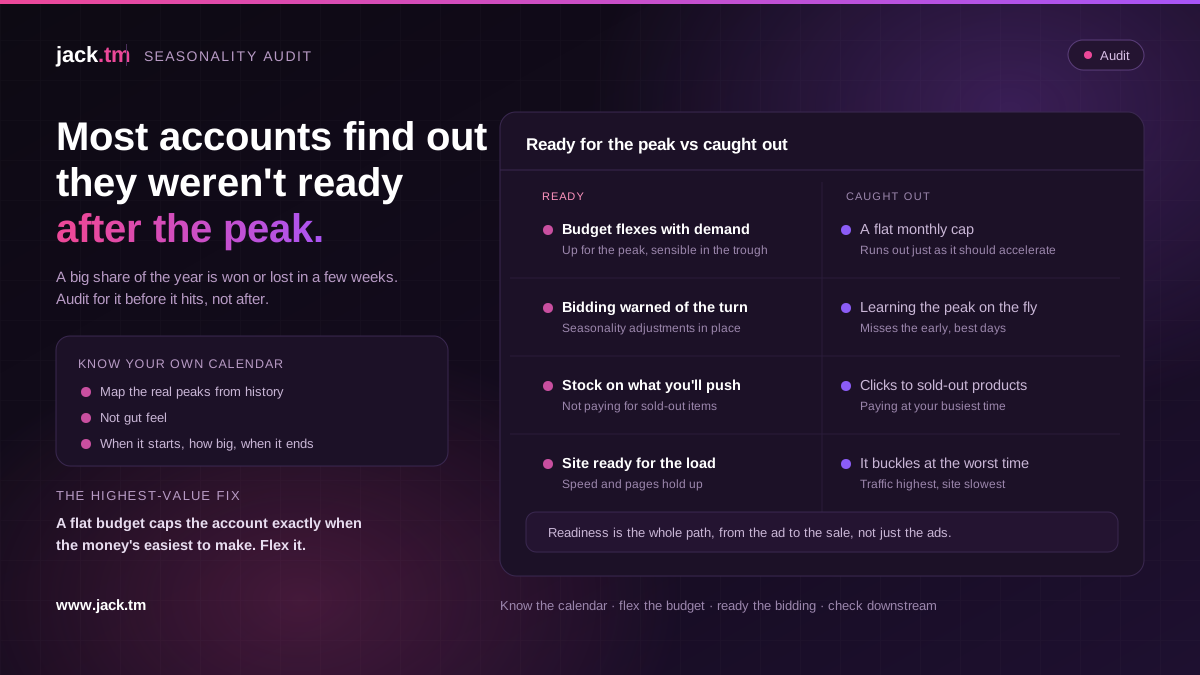
Most businesses have a peak: a time of year when demand spikes and a big share of the year's revenue is won or lost in a few weeks. And most accounts find out whether they were ready for it only after it has passed, which is the worst possible time to learn. A seasonality audit checks the account against its own calendar before the peak hits, so you capture the demand instead of watching it go by while you scramble. Here is how to audit for seasonality and what it looks at.
Know your own calendar first
The audit starts by establishing when the account's peaks and troughs actually are, from its own history rather than assumptions. Some seasonality is obvious, the retail run-up to the end of the year, but a lot is specific to the business and only visible in the data: a quiet summer, a back-to-work surge, a monthly or weekly rhythm, a spike tied to an event. Pull enough history and the real pattern shows itself, and it is often not quite what people assume.
This matters because you cannot prepare for a peak you have not correctly identified. The audit looks back over the last couple of years to map when demand rises and falls, how sharply, and for how long. That map is the foundation for everything else, because being ready for a peak means knowing exactly when it starts, how big it gets, and when it ends. Guessing from gut feel is how businesses prepare for the wrong weeks and miss the right ones.
Will the budget be there when the demand is?
The single most common seasonal failure is budget. In a peak, demand surges, which means more profitable clicks are available than usual, and a budget set for a normal month runs out early and caps the account exactly when it should be spending more. You leave money on the table at the one time of year the money is easiest to make, because the budget was not raised to meet the demand.
So a seasonality audit checks whether the budget is set to flex with the season or stuck at a flat monthly figure. If the profitable demand in the peak is greater than the budget allows, the account will hit the cap and stop just as it should be accelerating. The audit also looks at the reverse: budget sitting at full level through a known trough, spending into weak demand that was never going to convert well. Matching the budget to the calendar, up for the peak, sensible in the trough, is the highest-value seasonal fix there is, and the one most accounts miss.
Does the bidding have time to react?
Automated bidding is powerful but it learns from recent data, which creates a specific seasonal risk: it can be slow to react to a sharp change, bidding on last week's demand just as this week's spikes or collapses. Going into a fast peak, the bidding may underbid at first because it has not yet seen the surge, missing the early, often most valuable, days. Coming out of one, it may keep bidding high into fading demand.
A seasonality audit checks whether anything is in place to help the bidding through these turns. Google offers seasonality adjustments for exactly this, a way to tell the system a short, sharp change is coming so it does not have to learn it the slow way, and the audit checks whether they are being used for known events. It also checks the timing of any changes, because making big adjustments right as the peak starts can reset the bidding's learning at the worst moment. The goal is a bidding setup that is ready for the turn before it happens, not one caught flat-footed and learning the peak on the fly while the best days slip past.
Is the rest of the account ready to convert the surge?
Finally, a seasonality audit looks beyond the ads to whether the business can actually handle the peak it is trying to capture. There is no point driving a surge of traffic to a site that falls over under load, to products that will sell out on day two, or to a checkout that cannot cope. The account can be perfectly prepared and still waste the peak if everything downstream is not.
So the audit checks the practical readiness: stock on the products you will push hardest, so you are not paying for clicks to sold-out items at your busiest time; landing pages and site speed, which matter most exactly when traffic is highest; and the offer itself, whether it is sharp enough to convert the extra demand. Seasonal readiness is not only an ads question, it is whether the whole machine, from the ad to the sale, is prepared for the busiest weeks of the year. Audit it before the peak, not after, and you go into your most important weeks ready to capture the demand rather than discovering too late where the account was going to buckle.
FAQs
What is a seasonality audit? A review that checks a Google Ads account against its own seasonal calendar before a peak, covering whether the budget will flex with demand, whether the bidding is ready for the turn, and whether the wider business can convert the surge. The aim is to be ready before the peak, not after.
How do I know when my account's peak is? From its own history, not assumptions. Pull a couple of years of data and map when demand actually rises and falls, how sharply and for how long. A lot of seasonality is specific to the business and only visible in the data, and often not what people assume.
Why is budget the most common seasonal failure? Because a budget set for a normal month runs out early in a peak, capping the account exactly when more profitable clicks are available than usual. You leave money on the table at the one time of year it is easiest to make. Flexing the budget with the season is the highest-value seasonal fix.
How does seasonality affect automated bidding? Smart Bidding learns from recent data, so it can be slow to react to a sharp change, underbidding as a peak starts or overbidding as it fades. Seasonality adjustments can warn it a short, sharp change is coming, and the audit checks these are used and that big changes are not made right as the peak begins.
Is seasonal readiness just about the ads? No. The account can be perfectly prepared and still waste the peak if the site falls over, the products sell out, or the checkout cannot cope. A seasonality audit checks stock, landing pages, site speed and the offer, because readiness is about the whole path from ad to sale.