The Negative Keyword Audit: Finding the Searches You're Paying For by Mistake
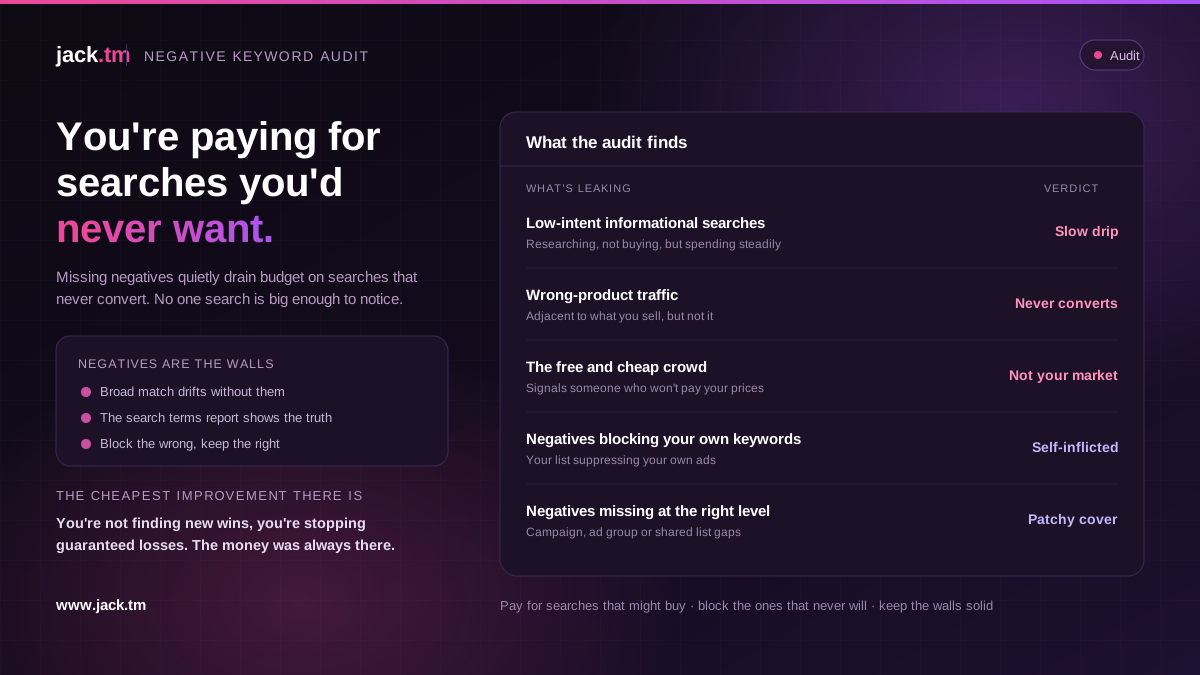
Most accounts are paying for searches the business would never want, and the reason is almost always the same: missing negative keywords. It is one of the least glamorous parts of a Google Ads account and one of the most expensive to neglect. A negative keyword audit goes through what you are actually matching to and finds the searches quietly draining budget for nothing. Here is what it checks and the waste it usually turns up.
Negatives are how you control what you pay for
Your keywords tell Google what to show for; your negative keywords tell it what not to. Without a solid negative list, especially on broad and phrase match, your ads drift onto searches that are loosely related but commercially useless: the wrong products, the wrong intent, people looking for something free when you sell paid, researchers who will never buy. Every one of those is a click you pay for and a conversion you never get.
The audit starts from the premise that a keyword without good negatives around it is a leak waiting to happen. The broader your match types, the more Google explores, and the more it explores, the more negatives you need to keep it on track. An account with aggressive match types and a thin negative list is almost guaranteed to be spending on rubbish, because nothing is stopping it. Checking the negatives is checking the walls of the account, and a lot of accounts have gaps in them.
What the audit actually looks for
The core of the audit is the search terms report, the list of what people actually typed to trigger your ads, as opposed to the keywords you bid on. This is where the truth lives. Going through it reveals the irrelevant searches you are paying for: wrong-intent terms, competitor names you do not want, job-seekers, the word "free" or "cheap" when that is not your market, product variants you do not sell, whole categories that have nothing to do with you. Each pattern is a negative keyword waiting to be added.
Beyond finding missing negatives, the audit checks the ones you already have for problems. Negative keyword conflicts are common and costly: a negative that accidentally blocks a keyword you are actively bidding on, so your own ads are being suppressed by your own list. It also looks for negatives that are too broad and blocking more than intended, and for the same negatives being missing at the right level, campaign, ad group or list, so the protection is patchy. A negative list is not just about what you have blocked, it is about blocking the right things in the right places without blocking the wrong ones.
Where the money usually hides
In practice, the waste a negative audit finds tends to cluster. There is the slow drip of low-intent informational searches, people researching, not buying, that convert rarely but spend steadily. There is the wrong-product traffic, searches for things adjacent to what you sell but not it, which look relevant in a report but never convert. And there is the free and cheap crowd, searches that signal someone who will not pay your prices, soaking up clicks on a market that was never yours.
None of these is dramatic on its own, which is exactly why they survive. No single wasted search is big enough to notice, so the leak runs for months. Added up across an account, though, it is often a meaningful slice of the budget going on traffic that had no chance of converting. Pointing that spend back at the searches that do convert is some of the cheapest performance improvement available, because you are not finding new wins, you are stopping guaranteed losses. The money was always there; it was just leaking out through searches nobody was blocking.
Turning the audit into action
A negative keyword audit is only useful if it ends in a tidier, tighter account, so it finishes with action, not just a list. The missing negatives get added at the right level, campaign-wide where the term is never wanted, ad group where it is more specific, shared lists where the same exclusions apply across campaigns. The conflicts get resolved so your own negatives stop blocking your own keywords. And the match types get a look too, because if broad match is generating a flood of junk, part of the fix might be tightening the keywords, not just endlessly adding negatives to catch what they let in.
The deeper value is that it is not a one-off. Search behaviour changes, new irrelevant terms appear, and a negative list that was clean six months ago will have gaps again. The best accounts treat negative keywords as ongoing hygiene, reviewing the search terms report regularly and topping up the list, so the walls stay solid. An audit gets you to a clean state; a habit keeps you there. Either way, the goal is simple: pay for the searches that might buy, and stop paying for the ones that never will.
FAQs
What is a negative keyword audit? A review of what searches your ads are actually matching to, using the search terms report, to find irrelevant ones draining budget and add negative keywords to block them. It also checks your existing negatives for conflicts and gaps.
How do missing negatives waste money? Without negatives, especially on broad and phrase match, your ads drift onto loosely related but useless searches: wrong intent, wrong products, people wanting free when you sell paid. You pay for those clicks and get no conversions. The waste is small per search but adds up.
What's a negative keyword conflict? When a negative keyword accidentally blocks a keyword you're actively bidding on, so your own list suppresses your own ads. It's common and costly, because you lose impressions you wanted and may not realise why. An audit finds and resolves these.
Where does the wasted spend usually hide? In three clusters: low-intent informational searches that rarely convert, wrong-product traffic adjacent to what you sell, and the free or cheap crowd who won't pay your prices. None is big alone, which is why they survive for months and add up to real money.
Is a negative keyword list a one-off job? No. Search behaviour changes and new irrelevant terms keep appearing, so a list that was clean six months ago will have gaps again. The best accounts review the search terms report regularly and top up the negatives as ongoing hygiene.