The Location Audit: Where Your Budget Works, and Where It's Wasted
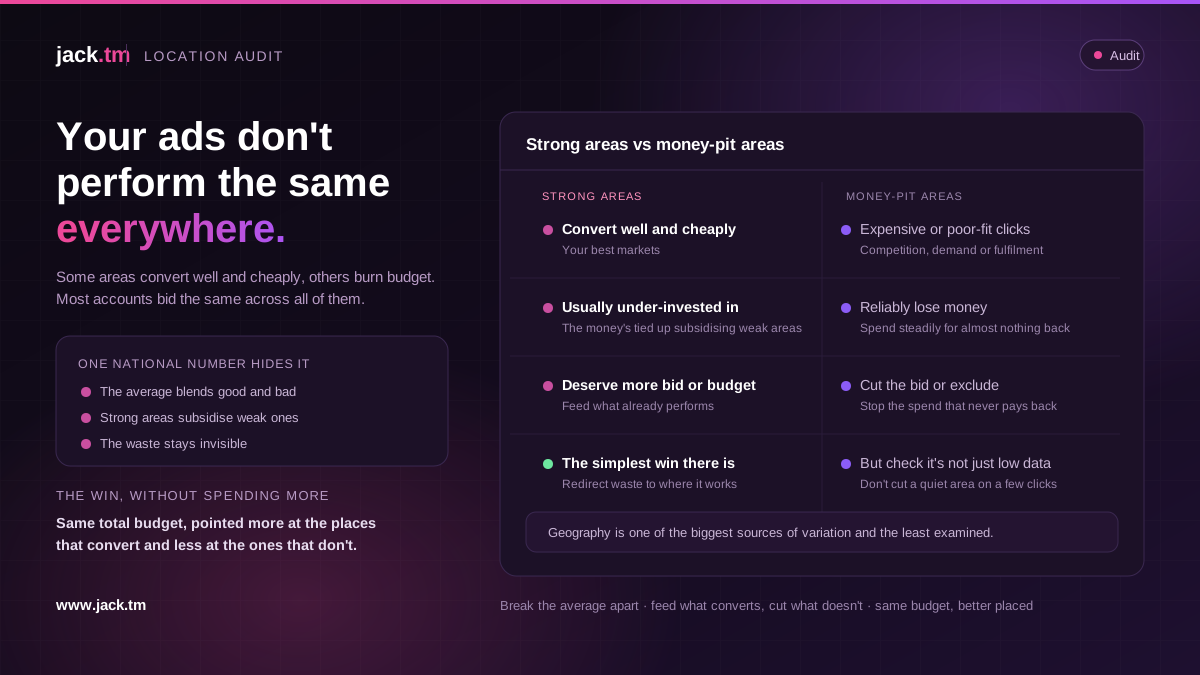
Your ads do not perform the same everywhere, but most accounts bid as if they do. Some areas convert well and cheaply, others burn budget and rarely pay back, and a lot of accounts are blind to the difference because nobody has looked. A location audit breaks performance down by geography and finds where your money is working and where it is quietly wasted. Here is what it checks and the budget it usually frees up.
One national number hides a lot
When you look at an account's overall performance, you get an average, and an average blends the good areas with the bad until both disappear. A campaign running at an acceptable cost per acquisition nationally can be made up of some regions converting brilliantly and others losing money, with the strong ones subsidising the weak. The headline number looks fine, so nobody digs, and the waste in the poor areas carries on because it is hidden inside a healthy-looking total.
The location audit exists to pull that average apart. By breaking results down by region, city or even postcode-level area, it shows the spread that the national figure conceals: where you make money, where you break even, and where you spend steadily for almost nothing back. Almost every account that has not done this has a geographic pattern it did not know about, because geography is one of the biggest sources of performance variation and one of the least examined. The first value of the audit is simply seeing it.
Why areas perform so differently
The differences are not random, and understanding them matters as much as finding them. Some areas convert worse because of competition, where rivals are strong and clicks are expensive. Some because of demand, where your product fits the local market poorly. Some because of fulfilment, where you deliver slowly or not at all, so the clicks cannot convert even when the intent is there. And some areas look weak simply because volume is low and the data is noisy, which is a reason to be careful, not to cut.
The audit tries to tell these apart, because the fix depends on the cause. An area that is genuinely unprofitable, expensive clicks, poor fit, no realistic path to conversion, is one to pull back from. An area that looks weak only because it has barely any data is one to leave alone and keep watching, not to judge on a handful of clicks. Reacting to every low-performing region as if it were a problem would mean cutting places that are just quiet, so the audit weighs the why, not only the number, before recommending anything.
What the audit changes
Once the geographic picture is clear, the actions are usually straightforward. The strong areas, where you convert well and cheaply, often deserve more: higher bids through location adjustments, or simply the budget that was being wasted elsewhere redirected to where it works. These are your best markets, and most accounts under-invest in them because the money is tied up subsidising poor regions. Feeding the areas that already perform is one of the simplest wins a location audit surfaces.
The weak areas get the opposite treatment, in proportion to how bad and how certain they are. A region that reliably loses money gets a reduced bid or, if it is clearly hopeless, excluded altogether, so the spend stops going somewhere it never pays back. Between the two extremes, bid adjustments let you lean towards the better areas and away from the worse ones without the bluntness of all-or-nothing. The result is the same total budget pointed more at the places that convert and less at the places that do not, which lifts performance without spending a penny more. The money was always there. It was just going to the wrong postcodes.
FAQs
What is a location audit? A breakdown of your Google Ads performance by geography, region, city or smaller area, to find where your budget converts well and where it's wasted. Most accounts bid the same everywhere and never see the geographic pattern hidden in their national average.
Why does one national number hide problems? Because an average blends good and bad areas together. Strong regions subsidise weak ones, so the overall cost per acquisition looks fine while some areas lose money steadily. The waste survives because nobody breaks the number down to see it.
Why do areas perform so differently? Competition, local demand, and fulfilment all vary by place, so clicks cost more or convert worse in some areas than others. Some regions also just look weak because volume is low and the data is noisy, which is different from genuinely losing money.
What does the audit change? It redirects budget towards the areas that convert well, through higher bids or reallocated spend, and pulls back from the ones that reliably lose money, through reduced bids or exclusions. Same total budget, pointed more at places that work, which lifts performance without spending more.
Should I cut every low-performing area? No. Some areas look weak only because they have little data, not because they're unprofitable. Cutting those on a handful of clicks is a mistake. The audit weighs why an area underperforms before recommending a reduced bid or exclusion.