Google Ads Audit for Lead Gen vs Ecommerce: What Changes
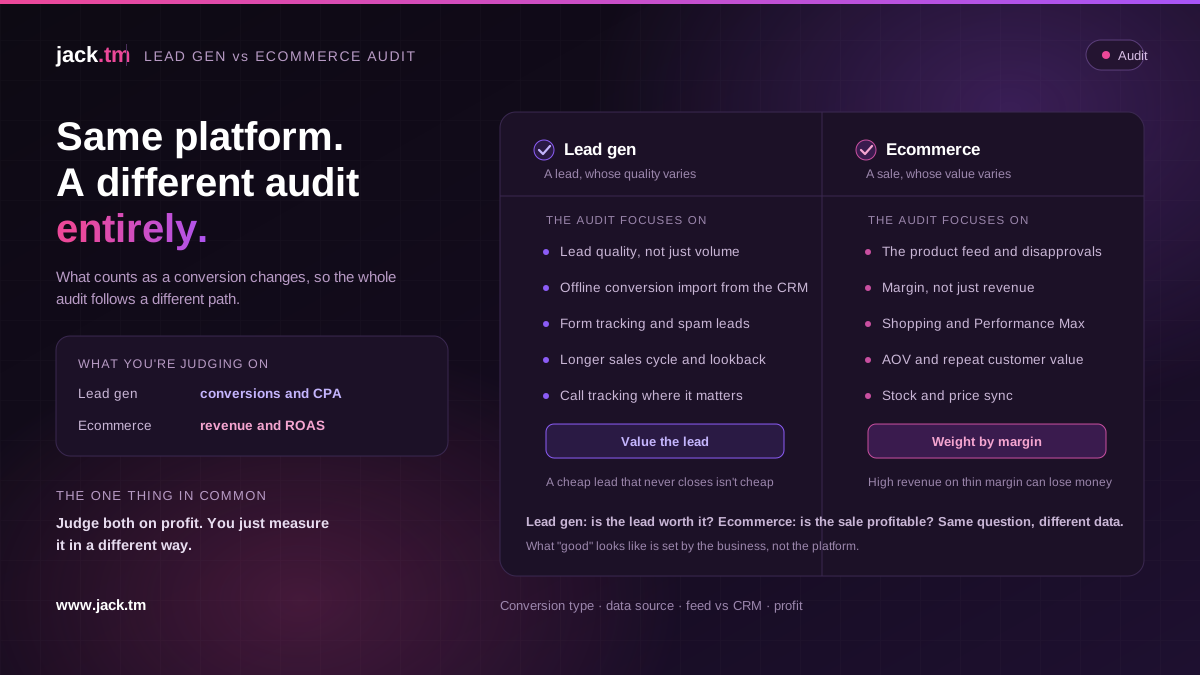
Most Google Ads audits are sold as one thing. They aren't. A lead gen account and an ecommerce account fail in different ways, so auditing them the same way misses what actually matters.
The short version: an ecommerce audit is judged on revenue and return on ad spend, so it lives in the product feed, Shopping and the value of each sale. A lead gen audit is judged on cost per lead and lead quality, so it lives in conversion tracking, form quality and what happens after the click. Same platform, different questions.
Here's exactly what changes, section by section, so you know what a proper audit should be checking for your account type.
The one difference that drives everything else
Ecommerce has a clean, automatic success metric: revenue. A sale is worth what the customer paid, and Google can see it the moment it happens.
Lead gen doesn't. A form fill is not a sale. It's a maybe. Two accounts can both report a £30 cost per lead, and one is printing money while the other is drowning in junk enquiries. The money is made or lost after the lead, somewhere Google usually can't see.
That single difference changes what an audit has to prove. For ecommerce, the audit checks that revenue is tracked accurately and spent efficiently. For lead gen, the audit has to check whether the leads are even real before any efficiency number means anything.
Conversion tracking: the biggest split
This is where the two audits diverge most.
For ecommerce, the audit checks that revenue is being captured correctly. Is purchase value passing through on every transaction? Does the value in Google Ads match the value in GA4 and in the actual back end? Are you double-counting, or counting tax and shipping when you shouldn't? A 10% error in tracked revenue quietly corrupts every bidding decision the account makes.
For lead gen, the audit checks something harder: are you counting the right action, and can you tell a good lead from a bad one? A lead gen account that optimises to raw form fills will happily buy you a flood of worthless enquiries. The audit should be looking for offline conversion tracking, so a closed deal or a qualified lead is fed back to Google, not just the form submit. If that link to the CRM isn't there, the account is flying blind and no amount of bid tuning fixes it.
Simple test. For ecommerce, ask "is the revenue number right?" For lead gen, ask "does Google know which leads turned into money?"
The success metric you judge the account on
For ecommerce, it's return on ad spend and, better still, profit after ad spend. The audit should check whether targets are set on revenue or on margin, because hitting a 4x ROAS on a low-margin product can still lose money.
For lead gen, it's cost per lead and cost per qualified lead. The audit should check whether the account is managed to the cheap number (cost per lead) or the real one (cost per sale). An account optimised purely to cheap leads is usually the one haemorrhaging money on leads that never close.
Bidding strategy
The levers are the same. What you feed them is not.
Ecommerce leans on Target ROAS, because there's reliable revenue data to bid against. The audit checks the target is realistic, set on the right value, and not starving good products of budget.
Lead gen leans on Target CPA, or Maximise Conversions with a cap. The audit checks the account isn't chasing volume at the expense of quality, and that, where possible, bidding is pointed at qualified leads via offline conversions rather than raw form fills. Without that, Smart Bidding optimises hard towards whatever is cheapest to collect, which is rarely your best customer.
Campaign types and where the spend sits
Ecommerce audits spend most of their time in Shopping, Performance Max and the product feed. A huge share of ecommerce performance is decided in Merchant Center, not the campaign. So the audit digs into feed quality: titles, images, product types, disapprovals, and whether PMax is being allowed to cannibalise brand or hide its spend across channels.
Lead gen audits spend most of their time in Search. The questions are about keyword intent, match types, ad copy relevance and whether expensive broad terms are pulling in tyre-kickers. Lead form assets, call tracking and call-only campaigns get real scrutiny here, and barely feature in an ecommerce audit.
Search terms and keywords
Both account types need a search terms review, but for different reasons.
For ecommerce, you're looking for products that get clicks and no sales, search terms that don't match buying intent, and budget leaking to research queries rather than purchase-ready ones.
For lead gen, you're hunting the queries that generate cheap, useless enquiries: job seekers, DIY researchers, people after a free version, competitors. In lead gen, your negative keyword list is often doing more work than your keyword list. A good audit treats it that way.
Audiences and remarketing
Ecommerce remarketing is about the basket and the catalogue: cart abandoners, past purchasers, dynamic remarketing that shows the exact product someone viewed. The audit checks these lists exist, are populated, and feed the feed.
Lead gen remarketing is smaller and more about nudging a longer decision: people who started a form, visited a pricing or contact page, or downloaded something. The audit checks the account isn't wasting budget remarketing to people who already became a lead, and that exclusions are in place so you stop paying to chase someone who already called you.
Landing pages
For ecommerce, the audit cares about the product page and the checkout: speed, clarity, stock, and whether the ad sends people to the right page rather than a generic category.
For lead gen, the audit cares about the form and the offer: how many fields, how clear the value is, whether the page matches the ad's promise, and whether the phone number is easy to find. In lead gen a weak landing page doesn't just lower conversion rate, it changes the quality of who bothers to fill the form in.
Budget, seasonality and the sales cycle
Ecommerce is spiky. Peaks, sales events, Q4. The audit checks budgets flex with demand and that you're not capped during your best selling days.
Lead gen is slower and longer. A lead today might close in three months. The audit has to account for that lag, so it won't judge last month's spend on last month's closed deals, because the deals haven't happened yet. Judging a lead gen account on too short a window is one of the most common audit mistakes going.
The side-by-side
What the audit checks | Ecommerce | Lead gen |
|---|---|---|
Main success metric | ROAS, profit after ad spend | Cost per qualified lead |
Conversion tracking focus | Accurate revenue value | Offline conversions, lead quality |
Bidding | Target ROAS | Target CPA, qualified-lead bidding |
Where the spend sits | Shopping, PMax, product feed | Search, lead forms, calls |
Keyword work | Products with spend, no sales | Negatives to block junk enquiries |
Remarketing | Cart and catalogue | Form-starters, pricing-page visitors |
Landing page | Product page and checkout | Form, offer, phone number |
Timeframe to judge | Short, demand follows the calendar | Long, allow for the sales cycle |
The mistakes each one hides
Ecommerce accounts most often hide: broken or inaccurate revenue tracking, PMax eating brand traffic, and a messy feed holding back otherwise good campaigns.
Lead gen accounts most often hide: optimising to raw form fills instead of real leads, no offline conversion tracking, and a thin negative keyword list letting junk enquiries through. The account looks efficient on paper and loses money in the CRM.
Frequently asked questions
Is a lead gen Google Ads audit different from an ecommerce one?
Yes. An ecommerce audit is built around revenue, return on ad spend and the product feed. A lead gen audit is built around cost per qualified lead, conversion tracking and lead quality. The checklist overlaps, but the priorities and the success metric are different.
What's the single most important check for a lead gen account?
Whether offline conversion tracking is in place, so Google optimises towards leads that actually become customers, not just cheap form fills.
What's the single most important check for an ecommerce account?
Whether tracked revenue is accurate and matches the back end. Every bidding decision depends on that number being right.
Can one audit cover both?
For a business that does both, yes, but it has to run the two assessments separately. Blending them hides the problems, because the numbers that look healthy for one can be masking a failure in the other.
Get the right audit for your account
A good audit starts by asking what your account is actually for, then checks the things that matter for that goal. If you want the version built around your account type, lead gen or ecommerce, [book a free Google Ads audit] and you'll get findings specific to how your account makes money, not a generic checklist.